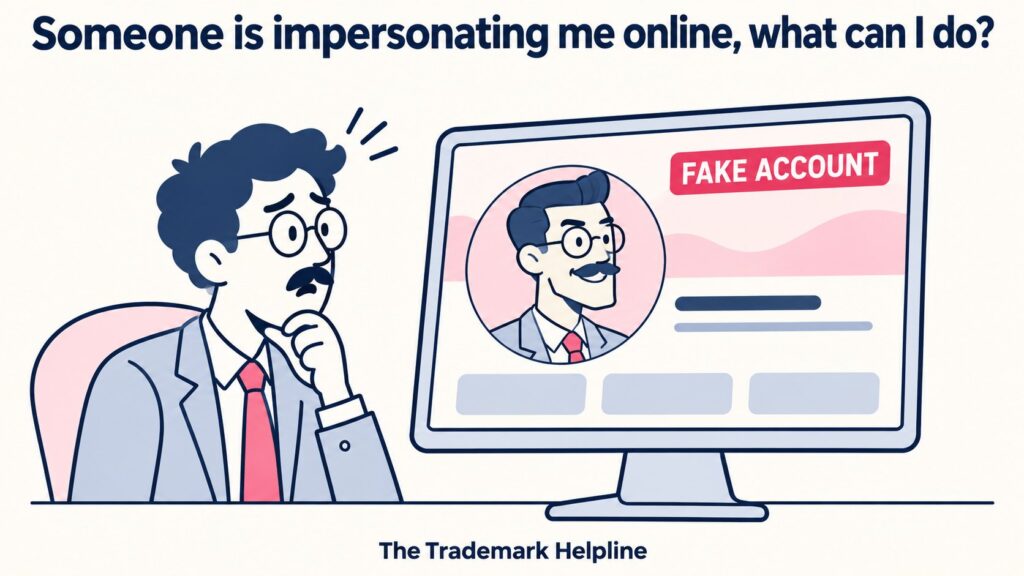
Act quickly, keep the evidence and report the fake account. If someone is impersonating you online, you don’t need a registered trademark to get a fake profile taken down. Every major platform has a route for it. But if they’re using your name to trade, a trademark gives you a stronger and faster one. Here’s the order we’d do it in.
A fake account does more than embarrass you. It borrows the trust you’ve built, and the people it hurts first are usually your customers and contacts, being asked for money by someone wearing your face. It’s a bit like someone copying your shop sign and hanging it over a stall down the road: anyone who walks in thinks they’re dealing with you.
Step 1: Save the evidence
Before you report anything, take screenshots of the profile, its posts and any messages. Note the full web address, the account handle, the date and any payment requests. Write down what makes it misleading, such as your photos, your bio or your contact details. When an account comes down, the evidence usually goes with it, and you may need it if the fake comes back.
Step 2: Report it to the platform
Facebook, Instagram, LinkedIn, TikTok and X each have an impersonation option in their reporting menus. Most also have a form you can use if you don’t have an account with them. Report the profile itself, not just a post, and choose “pretending to be me” or the nearest option.
If your own account has been taken over, use the platform’s account recovery process as well, change your email password and turn on two-step verification.
For a fake website, report it to the hosting company and to any payment provider it uses. The company the domain was registered through isn’t always the one hosting the site.
Step 3: Warn your contacts
Post a short warning on your genuine accounts explaining how people can check it’s really you. Don’t link to the fake; that only sends it traffic.
Step 4: If money is involved
Anyone who has paid can contact their bank straight away. Fraud can be reported to Report Fraud in England, Wales and Northern Ireland, or to Police Scotland on 101. If there are threats or anyone is in danger, call the police.
When a trademark helps
Impersonation isn’t automatically a crime on its own. Where your name is being used to sell something, though, a registered trademark lets you use the platform’s intellectual property complaint route, which is usually quicker and harder to ignore than a standard report. Trademark monitoring then helps you spot repeat attempts, because a fake that comes down once often comes back under a new handle.
If you’d rather we handled it, our personal brand protection service covers fake profiles. Where other rights need specialist advice, we coordinate help through our trusted panel of regulated partners.
Want to talk it through? Book a free 15 minute call, email enquiries@thetrademarkhelpline.com or call 0161 833 5400.
Related questions
- Will a trademark stop deepfakes and scams using my name?
- Can someone use my photo without permission in the UK?
- Is AI voice cloning illegal in the UK?
This answer is for information purposes only and does not constitute trademark advice or guidance. Last reviewed 3 November 2026.