Class 26: Haberdashery & Hair Accessories
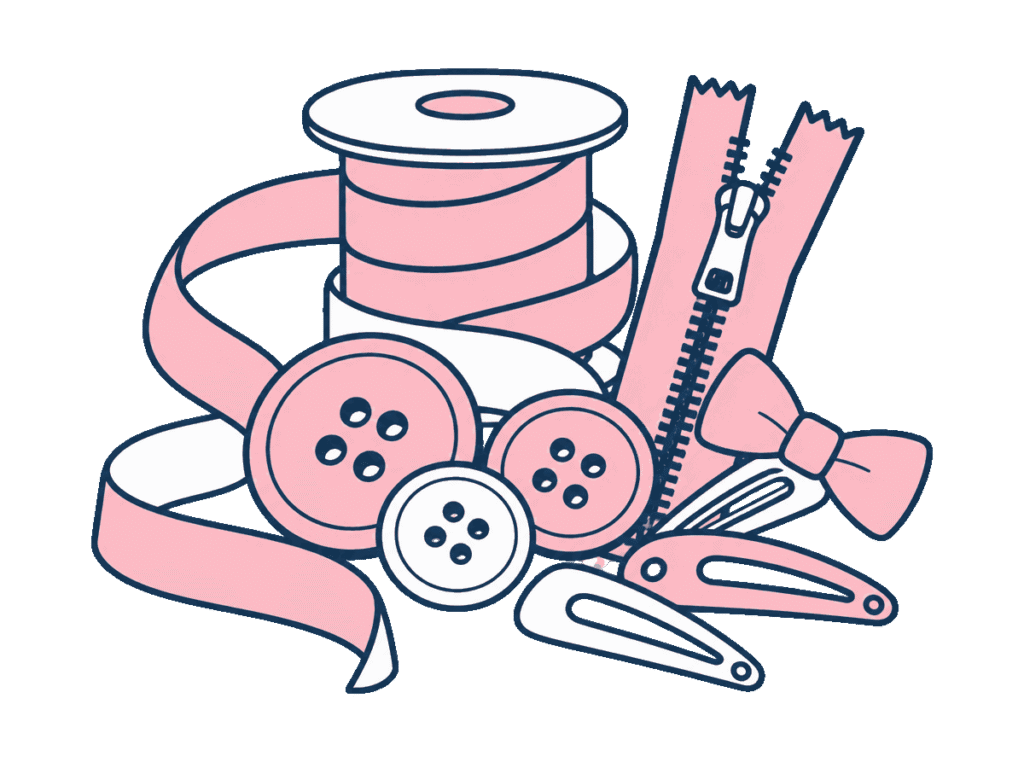
Class 26 covers the small things that finish a garment or a hairstyle: buttons, zips, lace, ribbons, needles and pins, artificial flowers, and hair accessories, wigs and hair extensions. It’s the 37th most used of the 45, with 9,111 UK registrations between September 2021 and September 2026, which is about 70% fewer registrations than the average class. It’s one of the quieter classes, which usually means less crowding. The surprise is who actually files here: far more hair and beauty brands than sewing brands.
What class 26 covers
This is the official Nice heading, in full:
Lace and embroidery, and haberdashery ribbons and bows; buttons, hooks and eyes, pins and needles; artificial flowers; hair decorations; false hair.
In practice there are three groups. Haberdashery in the traditional sense: trims, fasteners, needles, pins, patches and sewing kits. Artificial flowers, garlands and wreaths. And hair: clips, bands, scrunchies, grips and bows, plus wigs, hair extensions and false hair. What ties them together is that they’re added to something else, rather than being the finished product.
When you definitely need class 26
- You sell hair accessories, such as clips, bands, scrunchies, grips or bows
- You sell wigs, hair extensions or hairpieces
- You sell buttons, zips, press studs, lace, ribbons or other trims
- You sell artificial flowers, garlands or wreaths
- You sell sewing, knitting or cross stitch kits, needles or pins
When you might need class 26 without realising
Because the class is small, a lot of the businesses that need it don’t think of themselves as haberdashers at all.
- Hair salons and hair care brands. The shampoo is class 3 and the salon is class 44, but branded scrunchies and clips sold at the till are class 26. Hair scrunchies appear on 1,232 registrations and hair clips on 1,445.
- Wig and extension suppliers. The hair itself is class 26, with hair extensions on 1,756 registrations and wigs on 1,581. Fitting it is a class 44 service.
- Clothing brands with branded hardware. Branded buttons, zips and patches sold on their own are class 26 goods, with buttons on 1,094 registrations.
- Florists and event stylists. Fresh and dried flowers are class 31. Silk or paper flowers, artificial garlands and wreaths are class 26, with artificial flowers on 2,054 registrations.
Not sure whether your products are class 26 or somewhere else? The free class tools below show you where businesses like yours actually file, or you can give us a call.
What businesses actually claim in class 26
These are the terms that turn up most often in recent UK class 26 registrations:
| Term | Marks using it | Share of class 26 | How common |
|---|---|---|---|
| artificial flowers | 2,054 | 22.5% | Most use this |
| hair bands | 1,976 | 21.7% | Most use this |
| hair extensions | 1,756 | 19.3% | Most use this |
| false hair | 1,677 | 18.4% | Most use this |
| wigs | 1,581 | 17.4% | Most use this |
| hair clips | 1,445 | 15.9% | Most use this |
| hair pins | 1,321 | 14.5% | Most use this |
| hair barrettes | 1,232 | 13.5% | Most use this |
| hair scrunchies | 1,232 | 13.5% | Most use this |
| human hair | 1,164 | 12.8% | Most use this |
The table is mostly hair. Artificial flowers lead on 2,054 registrations, but hair bands (1,976), hair extensions, false hair (1,677), wigs and a run of clips, pins, grips and scrunchies fill almost everything below it. Buttons are the only traditional haberdashery item in the top 15.
That tells you who uses the class today. Hair and beauty brands file here routinely, often listing six or seven hair accessory terms at once. If you sell one kind of clip, it’s usually worth naming the others you might add, since they cost nothing extra within the class.
What class 26 does not cover
Finished clothing is class 25, and that includes headbands worn as clothing. The trims are class 26, but the garment they’re sewn onto is class 25. The split is sharpest with headbands: hair bands are class 26, but headbands [clothing], the kind worn for sport, are class 25, on 10,908 registrations there. A brand selling both needs both classes.
Fabric is class 24. A sewing brand that sells cloth by the metre, fat quarters or quilting fabric alongside its buttons and ribbons needs class 24 for the fabric, where textiles appear on 1,659 registrations. Only the trims and fastenings stay in 26.
Yarn and thread are class 23. Knitting and cross stitch kits are class 26 as kits, but yarn and thread sold separately are class 23. Knitting yarn is on 217 class 23 registrations and embroidery thread and yarn on 277. A craft supplier selling both usually needs both.
Running a haberdashery shop is class 35. Making or branding your own buttons and ribbons is class 26. Selling other brands’ sewing supplies, in a shop or online, is a retail service in class 35. The two protect different things, and a craft shop with its own range often needs both.
Where these terms actually live
| Term | Belongs to | Marks using it |
|---|---|---|
| embroidery thread and yarn | Class 23 | 277 |
| knitting yarn | Class 23 | 217 |
| textiles | Class 24 | 1,659 |
| headbands [clothing] | Class 25 | 10,908 |
Each of these is a separate registration. A mark in class 26 does not cover any of them.
Hair products: the class 26 split
Because so much of this class is hair, it’s worth knowing where the rest of a hair range goes. Hair accessories, wigs and extensions are class 26. Brushes and combs are class 21. Hair dryers are class 11, and electric hair straighteners are class 8. Shampoo, colour and styling products are class 3, and so are false eyelashes and false nails, even though false hair is class 26. Salon services, including fitting extensions, are class 44.
A hair brand that started with scrunchies can end up needing five or six classes by the time it adds a brush and a straightener, which is worth planning before the first application rather than after.

The mistake I see most often
The mistake is using “haberdashery” as a label for the whole craft aisle. Class 26 is mainly trims, fasteners, needles, artificial flowers and hair decorations. Fabric, yarn, scissors and sewing machines all sit elsewhere.
Take a sewing brand selling its own buttons, ribbons and needles, plus fabric bundles, yarn, dressmaking scissors and a starter sewing machine. The buttons, ribbons and needles are class 26. The fabric is class 24, the yarn is class 23, the scissors are class 8 and the sewing machine is class 7. File only class 26 and most of what’s on the shelf isn’t covered.
The practical fix is to list every product line and check each one, rather than relying on the name of the aisle it sits in. A UK application can’t have classes added later, so it’s worth getting the list right at the start.
Is class 26 the right class for you?
If you sell hair accessories, wigs or extensions, trims and fastenings, sewing or knitting kits, or artificial flowers under your own brand, class 26 is very likely yours. If you also sell fabric, yarn, clothing or other brands’ products, look at classes 24, 23, 25 and 35 as well, and classes 3, 8, 11, 21 and 44 for a wider hair range.
Our free class tools build a specification from wording already accepted on real UK filings, so you can see what businesses like yours claim before you commit.
Common questions about class 26
Are headbands class 25 or class 26?
It depends on what the headband is for. A hair band, the elastic or fabric band that holds hair in place, is class 26. A headband worn as clothing, such as a sports sweatband, is class 25. If you sell both styles, it’s worth claiming both, since the wording on your specification is what decides the scope.
Do wigs and hair extensions go in class 26?
Yes. Wigs, hair extensions and false hair are all class 26, and together they’re among the most claimed terms in the class. If you also fit them, the fitting is a salon service in class 44, and the care products you sell with them, such as shampoo for extensions, are class 3.
I sell sewing and cross stitch kits. Which class?
The kits are class 26, and so are knitting kits and sewing boxes. What changes the answer is selling the parts separately: fabric on its own is class 24, yarn and thread are class 23, and scissors are class 8. A toy sewing set for children is class 28.
Are embroidered patches and badges class 26?
Embroidered patches, patches for clothing and badges for wear that aren’t made of precious metal are all class 26. The exception is anything sold as jewellery: a brooch as jewellery is class 14, while a brooch described as a clothing accessory is class 26. Embroidery as a service, done for customers, is class 40.
About these figures. Last researched 23 September 2026, from UK trademarks registered between September 2021 and September 2026 whose entry in this class is still active. That is current drafting practice rather than the historical register. Terms shown are those most frequently used in that period.
Four FREE ways to build your class 26 terms
Start with whichever you already have. They all live in the same place.
 Let us read your websiteBest if your site already describes what you sell.Start this tool →4Free AI toolAnswer a few questionsBest if you are pre-launch, or your site does not tell the whole story.Start this tool →
Is your brand name actually free to use?
Classes are half the picture. The other half is whether somebody already holds your name in them. Our free search checks the UK register in seconds, no sign up and nothing to pay.
 0161 833 5400