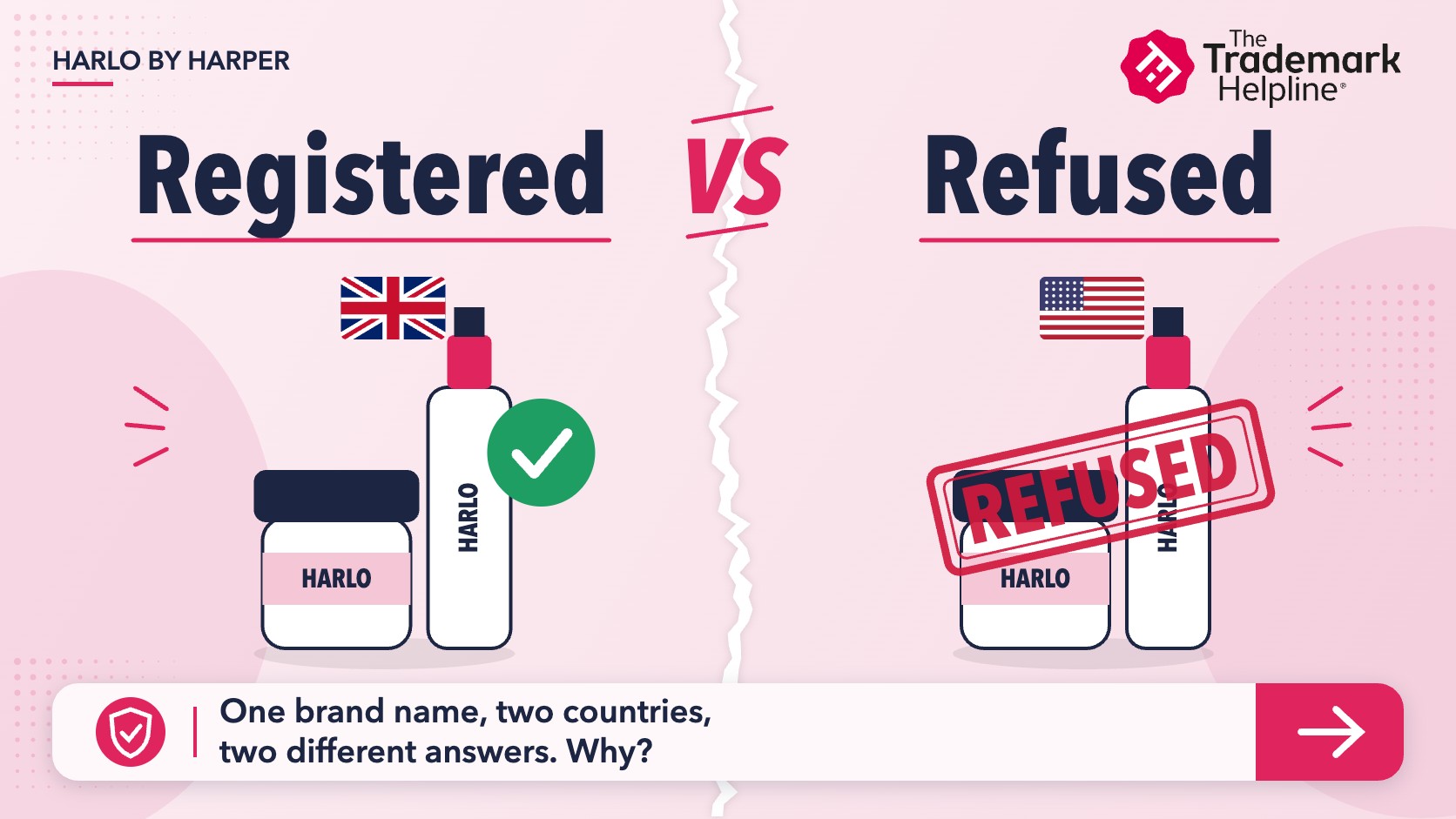
Harper Beckham’s beauty brand, HARLO BY HARPER, is registered as a trademark in the UK. In the United States, the same name has been refused. One brand, two very different answers, and the reason is simple: trademarks are territorial. A registration in one country tells you nothing about whether the name is free in the next one. If the Beckhams can run into that, so can any business with plans to sell abroad.
What happened with HARLO BY HARPER?
According to reports this week, the US trademark office has issued an initial refusal against HARLO BY HARPER because another business already owns a US registration for HARLO. That business reportedly sells dietary supplements. Harper’s brand is beauty.
Different products, but the US examiner decided the goods are related closely enough that customers could assume a connection. The examiner’s letter says the extra words “BY HARPER” do not distinguish the marks. That’s a point worth remembering. People tend to remember the first word of a brand, and adding your own name to the end of somebody else’s trademark rarely solves the problem.
It is a first refusal, not the end of the road. The applicant can respond with arguments, evidence or an agreement with the earlier owner, and it may well succeed. But it’s a delay nobody plans for.
Why was it accepted in the UK?
I checked the UK register. HARLO BY HARPER was filed on 8 July 2026, in classes 3, 5 and 35, and is now registered to a company called Project Seven US, Inc.
Here’s the interesting bit. The same company also owns a UK registration for HARLO on its own, in class 3, filed in January 2020. I don’t know how or when that earlier mark came to sit with the same owner. But whatever the history, in the UK the earlier HARLO and the new HARLO BY HARPER belong to the same proprietor, so there is nothing for them to clash with.
In America, the earlier HARLO belongs to somebody else. Same name, different register, different earlier rights, different outcome.
Is this the first name to hit trouble?
No. Before HARLO, the brand was going to be HIKU BY HARPER. That name is registered in the UK too, filed in October 2025. In the US, it received a provisional refusal in April 2026.
I can’t say trademark problems were the only reason for the change of name. Brands change direction for all sorts of reasons. What the sequence does show is that a good name has to work legally as well as creatively, and ideally in every country you plan to sell in.
Reports say around £3 million has gone into the business behind the brand. None of that buys the right to a name someone else already owns.
Why does a UK registration not cover America?
Trademarks are territorial. A UK registration protects your brand in the UK. It gives you no rights in the USA, the EU or anywhere else, and it certainly doesn’t prove your brand is safe to use overseas. Every country keeps its own register, with its own earlier rights.
Even the international system doesn’t get round that. HIKU BY HARPER’s US filing went through it. You make one application, but each country examines it under its own rules, and each one can say no. That’s why our international trademark registration service looks at each territory on its own before anything is filed.
This matters far more than it used to. A small business in Manchester can pick up American customers the day its website goes live. The internet removed a lot of borders. Trademark law didn’t.
What about Brooklyn’s trademark?
In June I wrote about the BROOKLYN BECKHAM trademark and who controls the rights to a family name. Checking the register again this week, nothing has changed. BROOKLYN BECKHAM is still registered to “Victoria Beckham, as parent and guardian of Brooklyn Beckham”. HARPER BECKHAM is registered the same way. Both date back to 22 December 2016.
Which means both are due for renewal on 22 December 2026, 67 days from today.
A ten year renewal is the moment to ask the questions that drifted while nobody was looking. Is the owner on the register still the right owner? Do the goods and services still match what the business sells? Should the trademark be assigned, licensed or updated before it’s renewed? Our trademark renewals service deals with exactly that, rather than simply paying the fee and filing it away for another decade.
What can a small business take from this?
Brooklyn’s story is about ownership. Harper’s is about clearance. Together they show that a famous name, a successful business or a healthy bank balance doesn’t give you automatic rights to a trademark.
The Beckhams have the resources to work through a refusal. A small business that has already paid for branding, packaging, photography and a website has far less room to manoeuvre. A late conflict can mean delays, legal costs, unusable stock and, sometimes, an expensive rebrand.
- Check before you invest. A free trademark search shows what’s already on the UK register. A Trademark Clearance Audit and Consultation goes further, looking at similar marks, related goods and services and the countries you want to sell in.
- Think about overseas markets early. It’s far cheaper to clear a name in America before the first export order than after it.
- Don’t rely on adding words. “BY HARPER” didn’t separate HARLO from HARLO. Your name on the end of someone else’s brand probably won’t either.
- Remember a company name isn’t a trademark. Being accepted at Companies House doesn’t mean the name is free to use as a brand, as our article on what protection a Companies House name gives you explains.
- Register in the right name. UK trademark registration is the foundation, but who is named as owner matters just as much, years later.
- Treat renewal as a review, not a formality.
Before you invest in building a brand, invest in checking you can use it. Even the Beckhams aren’t immune.
If you’re launching a new brand, planning to sell overseas or have a renewal coming up, book a free 15 minute call, email enquiries@thetrademarkhelpline.com or ring 0161 833 5400.
Related questions
- Someone in another country is using my brand. Can I stop them?
- Is the Madrid Protocol the cheapest way to protect my brand abroad?
- Do I own my trademark, or does my company?
- Can someone steal my business name?
This article is for information purposes only and does not constitute trademark advice or guidance. Last reviewed 16 October 2026.