Someone has copied part of your brand. Can you sue them?
Usually yes, if you hold a registered trademark covering what they’ve taken. But holding one doesn’t mean you win, and it doesn’t mean the copy has to stop. A registration gives you standing to act and a much faster route to acting. It does not hand you an outcome.
Christian Louboutin found that out in the most public way possible.
He had the registration. He had one of the most recognisable brand features in fashion. He sued, and the court agreed his red soles were a valid trademark. He still couldn’t stop the shoe he’d gone to court over.
That gap between being right and getting what you want is the part nobody explains, so it’s worth going through properly.
What happened between Louboutin and YSL
Louboutin started painting the soles of his shoes red in the early 1990s. Over time it became the thing people recognised. You could see a black shoe across a room, catch the flash of red underneath, and know whose it was without reading a label.
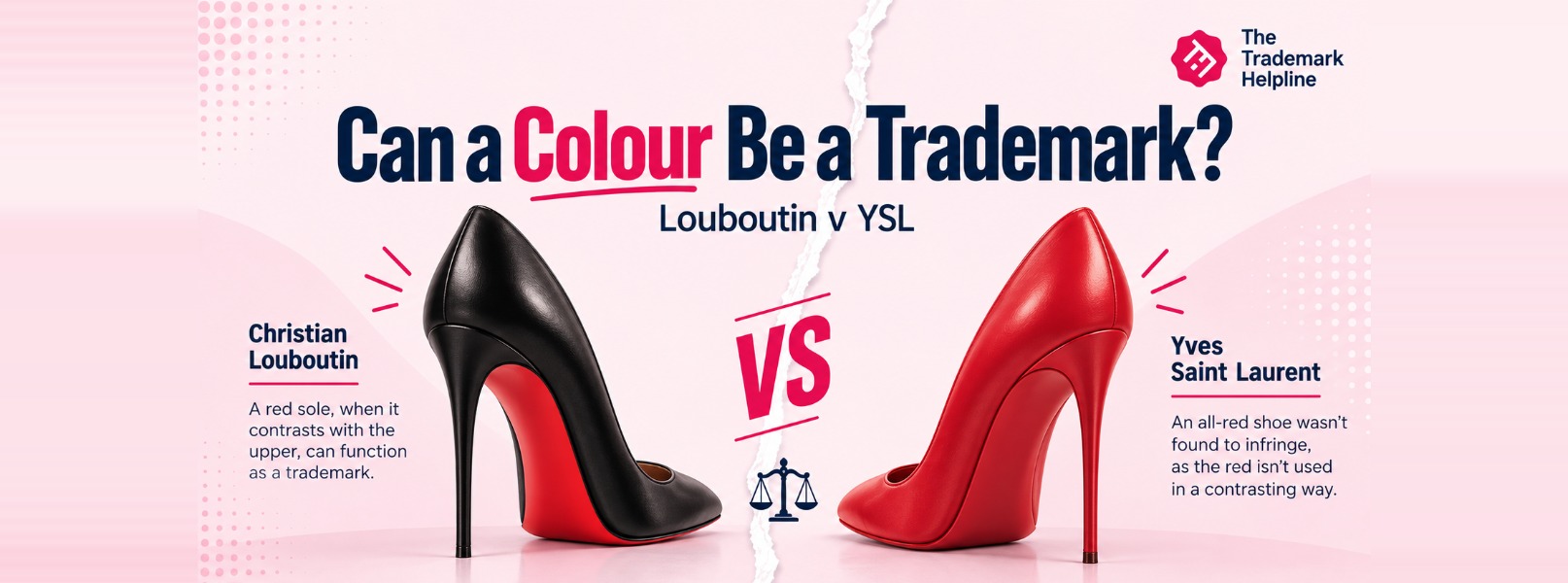
In 2011 Yves Saint Laurent released a shoe that was red all the way through. Red upper, red sole. Louboutin sued.
The first court went badly for him, holding that a single colour could never function as a trademark in the fashion industry. That was a genuinely alarming result for brand owners, because it would have put every colour-based brand asset beyond protection in one of the industries where they matter most.
On appeal in 2012, the US Court of Appeals for the Second Circuit reversed that. It held the red sole had acquired what American law calls secondary meaning and was a valid trademark.
Then it limited the right. The protected mark was the red outsole where it contrasts with the colour of the rest of the shoe.
YSL’s shoe had no contrast. Red on red. Because the mark as limited didn’t reach that far, YSL’s monochrome shoe fell outside it.
Louboutin won the principle and lost the shoe.
So what did the registration actually buy him?
Quite a lot, and it’s worth being specific rather than treating the outcome as a defeat.
He got a ruling that a colour used in a particular way can be a trademark in fashion, which protected the asset he’d spent twenty years building. He got the mark confirmed on the register with its scope clarified. Every future copyist now deals with a right that has been tested in court rather than one that might collapse the first time somebody pushes back.
What he didn’t get was the thing most people assume a trademark delivers: an automatic stop.
That’s the misunderstanding I come across most often. Registering a trademark doesn’t put up a barrier. Nobody is prevented from doing anything. Someone can still launch a lookalike, build a confusingly similar website, or list a copycat product tomorrow morning.
What changes is your position when you decide to do something about it.
What a registration actually gives you
Four practical things.
A cease and desist letter that lands differently. Most disputes end here. A letter pointing at a registration number is a different document from one asserting a reputation you’d have to prove, and recipients treat it differently.
Standing to oppose. If someone applies to register something too close to yours, a registration lets you object during the publication window rather than watching it go through.
Takedowns that work. Marketplaces, social platforms, domain registries and payment providers almost all want a registration number before they’ll act. This is where most real-world enforcement happens now, and it’s largely closed to you without one.
A shorter, cheaper argument if it does go further. You’re proving scope rather than proving the right exists.
That’s the honest value. Not prevention. Leverage, and speed.
When can’t you sue, even with a registration?
Three situations come up repeatedly.
The copy falls outside your registration. This is the Louboutin problem. Your right covers what you registered, in the categories you registered it for. If what they’ve done sits outside that, the registration doesn’t reach it.
They got there first. Earlier rights beat later ones. If someone has been using or has registered something similar before you, your registration may not help and can occasionally be attacked.
You’ve stopped using it. After five years on the register, an unused mark can be revoked, and the burden of proving use falls on you. Suing on a mark you haven’t used invites a counterattack.
None of these mean you’re without options. They mean the options are slower and more expensive.
What if you never registered anything?
You may still have a claim in passing off, but it’s a different animal.
You’d need to show goodwill in the market, a misrepresentation likely to make customers believe there’s a connection with your business, and damage flowing from it. All three, with evidence you have to go and assemble.
It’s genuinely useful and it’s genuinely harder work. Our Peloton case study walks through how it plays out in practice.
A registration doesn’t replace your reputation. It means you don’t have to prove it every time.
The part that decides everything: what you registered
The Louboutin case turns on one thing, and it isn’t the colour. It’s how the mark was described.
Louboutin didn’t register “red”. He registered a specific red, in a specified position, on a specified product. When a Dutch retailer later attacked the European registration, that precision is what saved it.
In Louboutin v Van Haren, decided by the Court of Justice of the European Union in June 2018, Van Haren argued the mark was invalid because it consisted exclusively of a shape giving substantial value to the goods, which is an absolute bar to registration. The court disagreed. The registration claimed a colour applied to the sole, with the outline of the shoe included only to show where the colour sat. A colour without an outline isn’t a shape, so the exclusion didn’t apply. The mark survived.
That judgment predates the end of the transition period and doesn’t bind UK courts now, though UK practice on position marks has followed similar logic. The practical lesson travels regardless.
Compare it with Cadbury’s long battle over its shade of purple. Nobody disputed that the public associated that purple with Cadbury. The problem was the description: wording about the colour being applied to the whole visible surface, or being the predominant colour, left it unclear what was actually claimed. A mark has to be defined precisely enough that a competitor can tell what they’re not allowed to do.
Cadbury had the recognition and lost on the definition. Louboutin had both.
If you take one thing from either case, take that. What you can enforce later is decided by what you write on the application now.
Can you protect things that aren’t names or logos?
Sometimes, and it’s worth knowing the boundary before you assume either way.
Businesses have secured protection for product shapes, packaging, sounds, patterns, position marks and colour combinations. Toblerone got its triangular prism through. Nestlé didn’t manage it with the four-finger KitKat. Same right, opposite outcomes.
What a trademark won’t do is protect how something works or what it does. That’s patents and design rights, and protecting the wrong thing leaves the valuable part exposed.
For most businesses this route isn’t available yet, and that’s not a failure. Distinctiveness of this kind is built over years of consistent use, and a new brand won’t have it. We’ve set out how that evidence works in our piece on acquired distinctiveness. The sensible move in the meantime is to protect the obvious things properly while the unusual ones develop.
What I’d actually do about it
If you think someone is copying you, the first question isn’t whether to sue. It’s what you hold and what it covers. That takes an afternoon to establish and it determines everything after it.
If you’re at the earlier stage and just want to know whether a name or feature is clear, our free trademark search is a sensible first move and costs nothing. If you know what you want to protect, our UK trademark registration service sets out what’s involved and what it costs, official fees included rather than buried.
And if there’s already a dispute in front of you, get the strength of the claim looked at before you reply to anything. Litigation is a tool, not an objective, and most of these end long before a courtroom.
You can book a free 15-minute call, email enquiries@thetrademarkhelpline.com, or call 0161 833 5400.
Because the most valuable part of a brand isn’t always the name on the box. Sometimes it’s the red sole underneath it.
This article is for information purposes only and does not constitute trademark advice or guidance.