
Update — August 2026: Companies House and the IPO have issued a joint warning, and the scam has widened
Since this article was published, the Intellectual Property Office and Companies House put out a joint warning about unsolicited payment requests, and the pattern has broadened beyond trademarks.
The letters and emails described below are still circulating, still arriving at your registered office address, and still asking you to pay to have your trademark renewed or added to an “exclusive online register”. We have kept naming the operators as they appear, and the list on our scam warnings has grown a long way past TPS.
What is newer is the direction. The same pattern is now being aimed at your Companies House account rather than your trademark: demands to pay to set up or claim your online account, or to authenticate it and verify your details. Those land plausibly because Companies House identity verification is something businesses genuinely have to deal with at the moment, so an invoice about it does not immediately look out of place.
Two additions to the checklist above are worth knowing.
First, check for a disclaimer. These letters frequently carry a line, usually in small print, stating that the sender is not affiliated with the government. It is there to keep them on the right side of the law, and it is one of the quickest ways to confirm what you are looking at.
Second, there is now a dedicated address for reporting. Suspicious invoices can be sent to misleadinginvoices@ipo.gov.uk, alongside reporting to Report Fraud and your local Trading Standards office.
The underlying advice has not changed. If a payment request was not expected, pause before paying anything, and call us on 0161 833 5400 if you would like it checked.
Source: Companies House and IPO joint warning, 21 May 2026
—
Over the last few years, we have seen a sharp rise in trademark scams targeting UK businesses. These scams are clever, convincing, and often arrive shortly after a trademark has been published or renewed.
As a UK Trademark Registration specialist, we see first-hand the stress and damage these scams can cause for business owners, so we wanted to explain what is happening, how they work, and what you can do to stay safe.
How the Scam Works
When you apply for a trademark, your details become public on the UKIPO register.
This means anyone can see the application name (your companies or the people who own the trademark), address, and filing information, this can include people who intend to use the information for the wrong reasons.
Scammers use this information to send letters or emails that look official. They often claim that a further payment is needed to maintain, publish, or renew your trademark, or make you believe you need to issue a European Application.
These letters can appear very convincing and often request payments of around £800. The money is sent to unverified companies overseas, and nothing is provided in return.
We have even seen scammers impersonate The Trademark Helpline, sending fake renewal notices using our name and branding (imitation is the sincerest form of flattery I guess). We shared what happened, and how we handled it, in our article We Got a 1-Star Review… You Won’t Believe Why.
Real Example: TPS “Trademark Publication” Scam
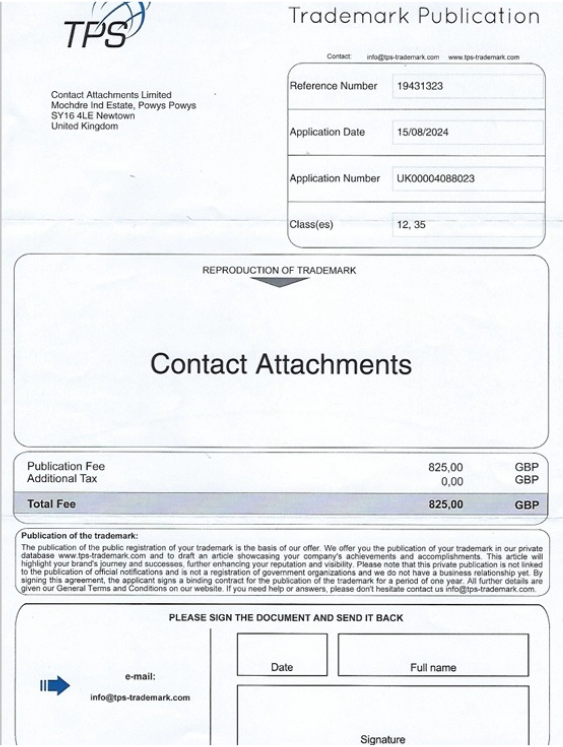
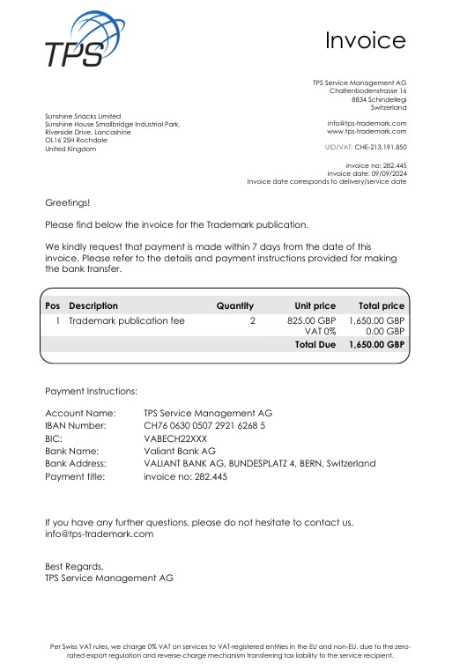
One recent example involves a company calling itself TPS Service Management AG. They send letters headed “Trademark Publication” or “Invoice”, asking for a £825 publication fee to include your trademark in what they describe as a private register.
On the surface, the documents look genuine. They include your application number, trademark name, and classes, all of which are taken directly from public records. Despite the professional layout, these letters have no link to the UK Intellectual Property Office.
They also request payment to a Swiss bank account, which is a clear warning sign and a strong indication that the company is not legitimate.
Important: The UK Intellectual Property Office never sends invoices or requests payment through third-party companies. Any official fees are always paid directly to the UKIPO or through your authorised representative (for example The Trademark Helpline) using the official government website.
You can read more about who the Intellectual Property Office are and the role they play here.
Example “Trademark Publication” Letter
Example “Invoice” Document
How to Recognise a Scam
Questions that you can ask that may help you spot a trademark scam before it catches you out. Look out for the following:
- Is the sender asking for payment for publication, registration, or renewal that you did not request?
- Is the amount being requested, higher than the official UKIPO fees?
- Is company name is unfamiliar or overly generic?
- Does the correspondence include overseas bank details or international payment instructions?
- Does the email address match the UKIPO or your authorised representative?
If you receive a letter or invoice like this, pause before making any payment.
What to do if you are not sure
If in doubt, don’t pay. You can always pick up the phone and call us on 0161 833 5400. Our team can confirm within minutes whether a notice is genuine and help you avoid unnecessary costs or stress.
What We Are Doing to Help
For clients who have the budget there are methods to create a layer of anonymity around trademark ownership such as holding trademarks in trust organisations without affecting your trademark rights, and ways to remain anonymous during the early stages of filing.
This is designed to help keep your details private and make it harder for scammers to harvest information from the public register. However, we strongly believe that the most cost-effective solution is simple diligence and if having professional representation.
As it stands today, no system is a substitute for professional advice and guidance.
How to Protect Yourself
- Only respond to official correspondence from the UKIPO or your authorised representative.
- Be cautious with any unexpected invoices or renewal reminders.
- Report suspicious letters or emails to Action Fraud and let your representative know.
- Keep your contact and representative details up to date with the UKIPO.
If you would like to learn about how you can enjoy the benefits of an having an in-house trademark team for a fraction of the cost, you can call us on 0161 833 5400 or book a quick chat with our team here.