When a company goes into administration, its trademark doesn’t disappear with it. A registered trademark is personal property, it belongs to the company, and once an administrator is appointed they take control of it along with everything else the company owns. They can sell it with the rest of the business, or sell it on its own. So the short answer to what happens to a trademark in administration is that it usually gets sold, and quite often it’s one of the few assets left with real value.
That’s why a familiar name can disappear from the high street and come back a few months later under a new owner, with different products and an entirely different management team behind it.
What happens to a trademark in administration?
The Trade Marks Act 1994 treats a registered trademark as personal property, and section 24 says it can be transferred like any other property, either with the goodwill of a business or independently of it. An administrator has a statutory power, set out in Schedule 1 to the Insolvency Act 1986, to sell or otherwise dispose of the company’s property. Put those two together and the brand becomes something that can be packaged, valued and sold to whoever makes the best offer.
Wilko is the obvious recent example. When it went into administration in 2023, the administrators sold the brand, the website and the intellectual property to The Range, while the stores were closed as part of the administration. The name carried on. The business around it, in the form most people knew it, didn’t.
That tells you what a buyer thought was worth paying for when everything else was on the table. The Range didn’t buy the shops. It bought the name.
Why can the brand be worth more than the business?
Because stock is often sold off, leases handed back and equipment sold at whatever it will fetch, while a name that customers still recognise, and still search for, can be bought and relaunched. One view I hold firmly is that trademark protection at exit matters more than most founders realise. Administration is the least comfortable version of an exit, but the logic is the same.
That only works if there is a clean, registered right to buy. An unregistered brand isn’t worthless, because goodwill can still pass with a business, but it’s much harder to value and much harder to prove, and a buyer picking through an insolvent company has neither the time nor the appetite for proving it.
What exactly are you buying?
This is where most of the problems sit, and it’s where a trademark consultation and clearance audit earns its keep. I’ll be blunt: buying the website or the remaining stock does not necessarily give you control of the brand.
The pieces that make up a brand are often not all owned by the same company. In a group, the trademark might be registered to a holding company while the trading company went under. It might be registered to a founder personally and licensed to the business, in which case it may not be the company’s to sell at all. The domain might be in a developer’s name. The logo artwork might have been created by a freelance designer who still owns the copyright, because copyright stays with the person who created it unless it was assigned in writing. There might be licences, coexistence agreements or security over the trademark that you need to know about. Pinning all of that down before the deal completes is exactly what an audit of the brand’s trademarks is for.
Administrators also sell on a very different basis to a normal seller. They’re typically dealing with a business they didn’t build, they need to move quickly, and they generally sell only such right, title and interest as the company actually has, with no warranties about ownership. In a normal sale you’d expect the seller to stand behind what they’re selling. Here, if the trademark turns out to be in the wrong name or to cover the wrong goods, that’s usually your problem, not theirs.
You might only need part of it
A buyer out of administration often wants one part of a business rather than the whole thing, and the brand rights need to follow the bit you’re actually buying and nothing else. A registration can be split so that only the relevant goods or services move to you, which is exactly what we looked at in our article on whether a trademark can be split in two. “We bought the brand” and “we bought the brand for these goods” are very different positions, and the difference tends to surface long after completion.
Check the territories
A UK registration covers the UK. If the brand traded in Europe or further afield, the overseas registrations are separate assets on separate registers, and each one needs checking and transferring in its own right.
How do you record a trademark transfer, and why does it matter?
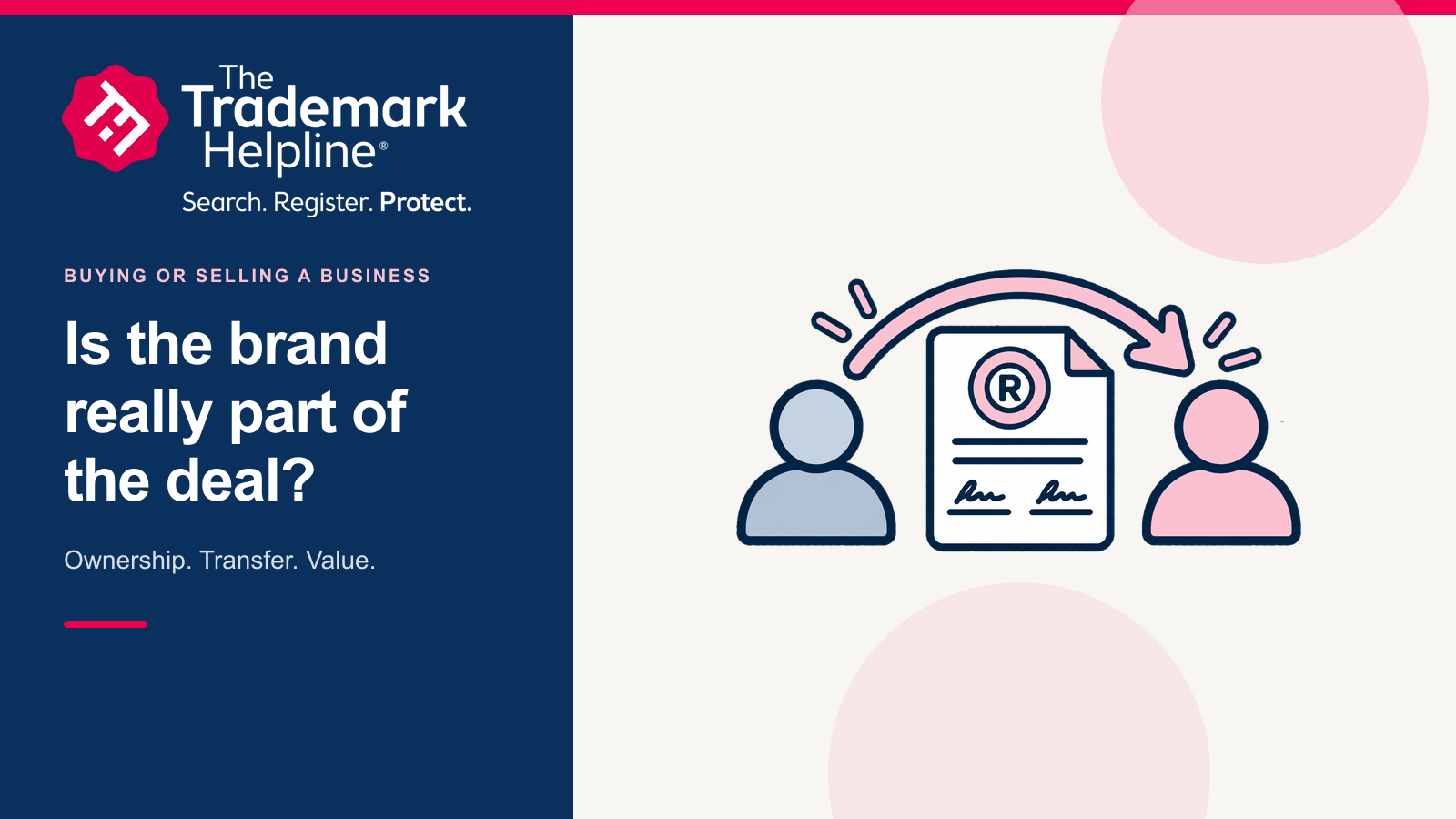
An assignment of a registered trademark has to be in writing and signed on behalf of the seller. Then the change of ownership needs recording with the UKIPO, which is done on form TM16. It’s routine admin, but in the rush to complete a distressed sale it’s easy for it to slip.
Skipping it has consequences. Under section 25 of the Trade Marks Act 1994, until the application to record the transfer is made, it’s ineffective against someone who acquires a conflicting interest without knowing about it. And if the mark is infringed before the transfer is recorded, the court won’t award the new owner their costs unless the application to record it was made within six months, or as soon as practicable after. That’s a painful way to find out a form was never filed. In the meantime the register may still show the old company, possibly one that no longer exists, as the legal owner.
Check the renewal date while you’re there. A mark bought out of administration can be months from expiry with nobody at the old company watching it, and our trademark renewal service sends early reminders and helps with the filing so it doesn’t lapse on your watch.
Can the original owners buy the brand back?
Sometimes, and it happens. A founder or director might want to buy the name out of their own company’s administration and carry on trading. There are rules around that. Under the Administration (Restrictions on Disposal etc. to Connected Persons) Regulations 2021, if all or a substantial part of the business or assets is sold to a connected person within the first eight weeks of the administration, the administrator needs either the creditors’ approval or a report from an independent evaluator first.
Commercially, I wouldn’t assume that because it was your brand, you’ll be first in line for it. An administrator acts in the interests of the company’s creditors as a whole, and a recognisable name attracts outside interest.
What does this mean if your business is perfectly healthy?
Most people reading this aren’t buying out of administration, and hopefully aren’t heading into one. The lesson still applies. Knowing exactly who owns your trademarks, and whether the register reflects the current position, is something I’d want settled long before anyone else is looking at it, whether that’s a buyer, an investor, a lender or, in the worst case, an administrator.
If you’re planning an exit, our article on trademarks when selling or buying a business covers the due diligence side in more detail. If you’re buying assets out of an insolvency, I’d look at the brand before the deal completes, not after, because once the money has gone there’s nobody left to go back to.
Our trademark consultation and clearance audit, from £99, looks at who owns the registrations, what they cover, where they’re protected and what’s missing. Where regulated legal advice is needed on the transaction itself, we can coordinate with our trusted panel of regulated partners. Once the brand is yours, our trademark representation and protection service puts official correspondence through us, so IPO notices and third-party approaches don’t land on a desk nobody’s sitting at. If you just want to see what’s on the register under a name, our free trademark search is the place to start. You can also book a free 15-minute call, email enquiries@thetrademarkhelpline.com or call 0161 833 5400.
Related questions
- Do I own my trademark, or does my company?
- If my business partner walked tomorrow, who owns the brand name?
- When should I trademark, before or after I launch?
- Can I register a trademark myself, or do I need an attorney?
This article is for information purposes only and does not constitute trademark advice or guidance. Last reviewed 25 September 2026. First shared as a LinkedIn post.
Questions about this
What happens to a trademark when a company goes into administration?
It does not disappear. A registered trademark is personal property belonging to the company, and once an administrator is appointed they take control of it along with everything else. They can sell it with the business or on its own. In practice the brand usually gets sold, and it is often one of the few assets left with real value, which is why familiar names can return under new owners.
 Answered by Jonathan Paton, Founder & CEO
What happened to the Wilko brand after administration?
When Wilko went into administration in 2023, the administrators sold the brand, the website and the intellectual property to The Range, while the stores were closed as part of the administration. The name carried on, but the business most people knew did not. It shows what a buyer considered worth paying for when everything was on the table: not the shops, but the name.
Answered by Jonathan Paton, Founder & CEOWhat should I check before buying a brand out of administration?
Check who actually owns each piece. The trademark may sit with a holding company, or with a founder personally, rather than the company that failed. The domain may be in a developer’s name, and logo copyright may still belong to a freelance designer. Look for licences, coexistence agreements or security over the mark, check the goods, territories and renewal date, and record the transfer with the UKIPO on form TM16.
Answered by Jonathan Paton, Founder & CEO