

Most founders could tell you who owns the shares. Far fewer could tell you, without checking, whose name the trademark is registered in.
It is the sort of detail that sits quietly in the background for years and then matters enormously, usually on the worst possible day.
Who legally owns a trademark, the person or the company?
Whoever is named as the owner on the register. Nothing else decides it.
Not who came up with the name. Not who paid the invoice. Not who has done the work of building the brand. The register records a proprietor, and that is the legal owner. When people ask who owns a trademark, the person or the company, that one line on the register is the whole answer.
That owner is often an individual, particularly where the application was made early on before the company existed, or where somebody filed it themselves and used their own name without thinking about it. Sometimes it is a company that has since been dissolved, or a holding company nobody has looked at in years.
None of that is unusual. It only becomes a problem when the people involved stop agreeing.
What happens if a co-founder leaves?
If the trademark is registered in their name, it goes with them.
They own the asset. The business may have been using it for years, but the registered right belongs to the person on the register. Depending on how things end, the business can find itself negotiating for the use of its own name, or rebranding.
The reverse is just as awkward. If the mark is in the company name and a founder leaves believing the brand was partly theirs, they may find they have no claim to it at all.
Neither situation requires anybody to have behaved badly. It usually just means nobody settled brand name ownership between business partners while everyone was getting along.
Where the brand carries a founder’s own name, the question gets sharper still. The Jo Malone dispute is the well known illustration of what happens when somebody sells a business built around their name and later wants to trade under it again.
Can a trademark be moved between an individual and a company?
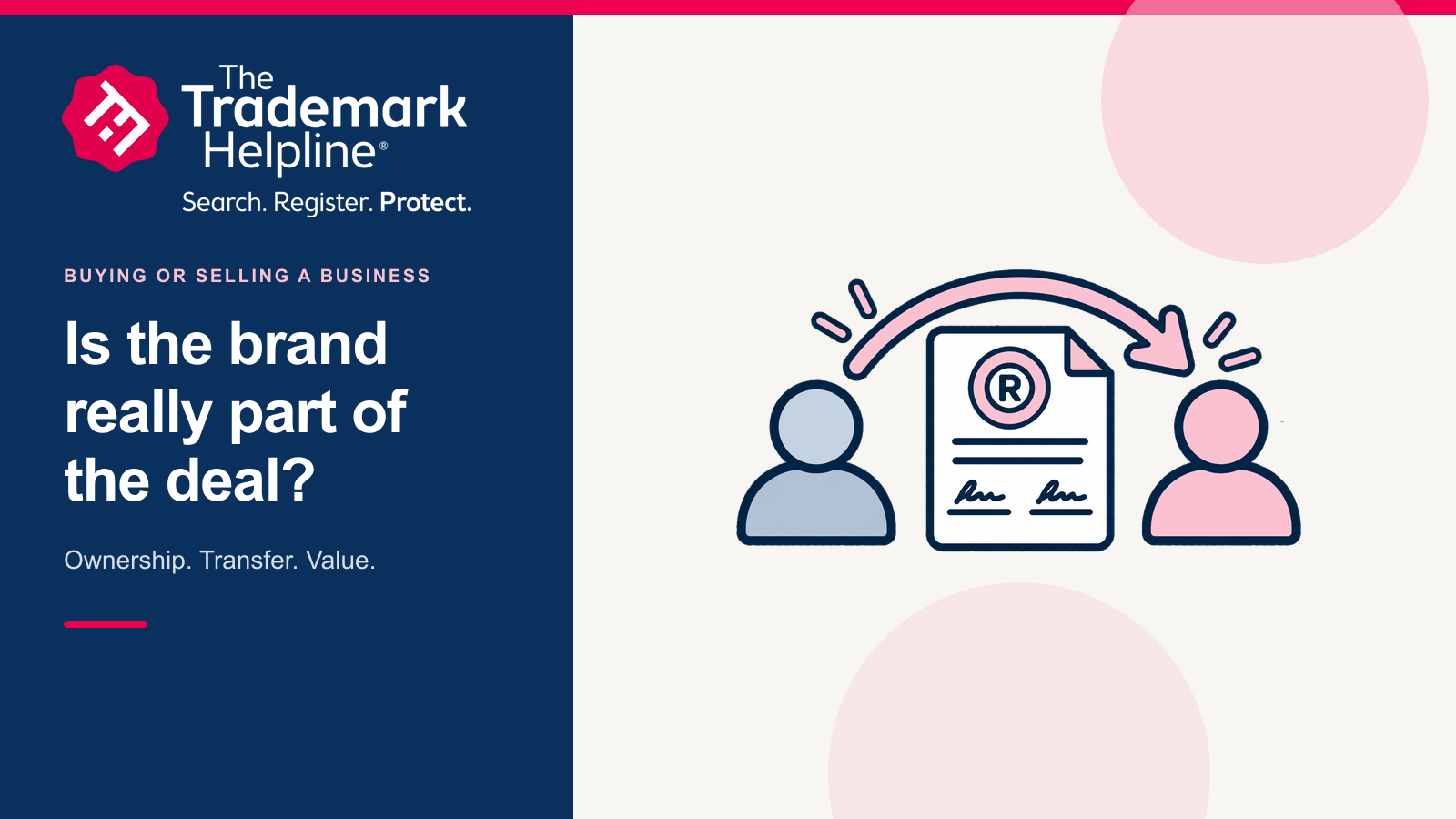
Yes. A registered trademark is property and it can be assigned, in the same way as any other asset. To transfer a trademark from an individual to a company is a recorded change of proprietor on the register rather than a fresh application.
It is a straightforward piece of work when everybody agrees. The difficulty is that the moment you most need to move it is usually the moment agreement is hardest to reach.
There is a related point worth knowing. If a mark sits with an individual but is used by the company, that use should be properly licensed, even informally documented. Otherwise you can end up in an odd position where the registered owner is not the one using the mark, which can create difficulties if the registration is ever challenged for non-use.
What does this mean if you ever sell the business?
Buyers check. Trademark ownership is one of the first things due diligence looks at, because the brand is often a substantial part of what they are paying for.
If the trademark is not owned by the company being sold, the deal does not necessarily collapse, but it stops while it gets fixed. Fixing it at that point means asking whoever holds it to assign it, at exactly the moment they have most to gain from saying no.
We have seen a name held personally by a founder who had long since left, a mark registered to a dissolved company, and a brand where two co-founders each assumed the other had dealt with it. All fixable. All much easier to deal with before the buyer asks.
What should you check now?
- Read the proprietor name on the register. Look up your own trademark and read what it actually says, not what you assume it says.
- Check that owner is the entity that is trading. The name on the register should be the business that is actually using the mark.
- If it sits with an individual, decide deliberately whether that is right. Sometimes it genuinely is. It should be a decision rather than an accident.
- Write the position down. If there is more than one founder, record it alongside the shareholders’ agreement.
- Move it while everybody is still on good terms. An assignment is easy when nobody has anything to gain from refusing.
- If the name is not registered at all, deal with that first. There is no proprietor to argue over until somebody files, and UK trademark registration is where that starts.
A trademark consultation and audit will tell you exactly what you own and in whose name, which for most businesses is the first time anyone has looked at it properly.
You can book a free 15-minute call, email enquiries@thetrademarkhelpline.com or call 0161 833 5400.
This article is for information purposes only and does not constitute trademark advice or guidance.