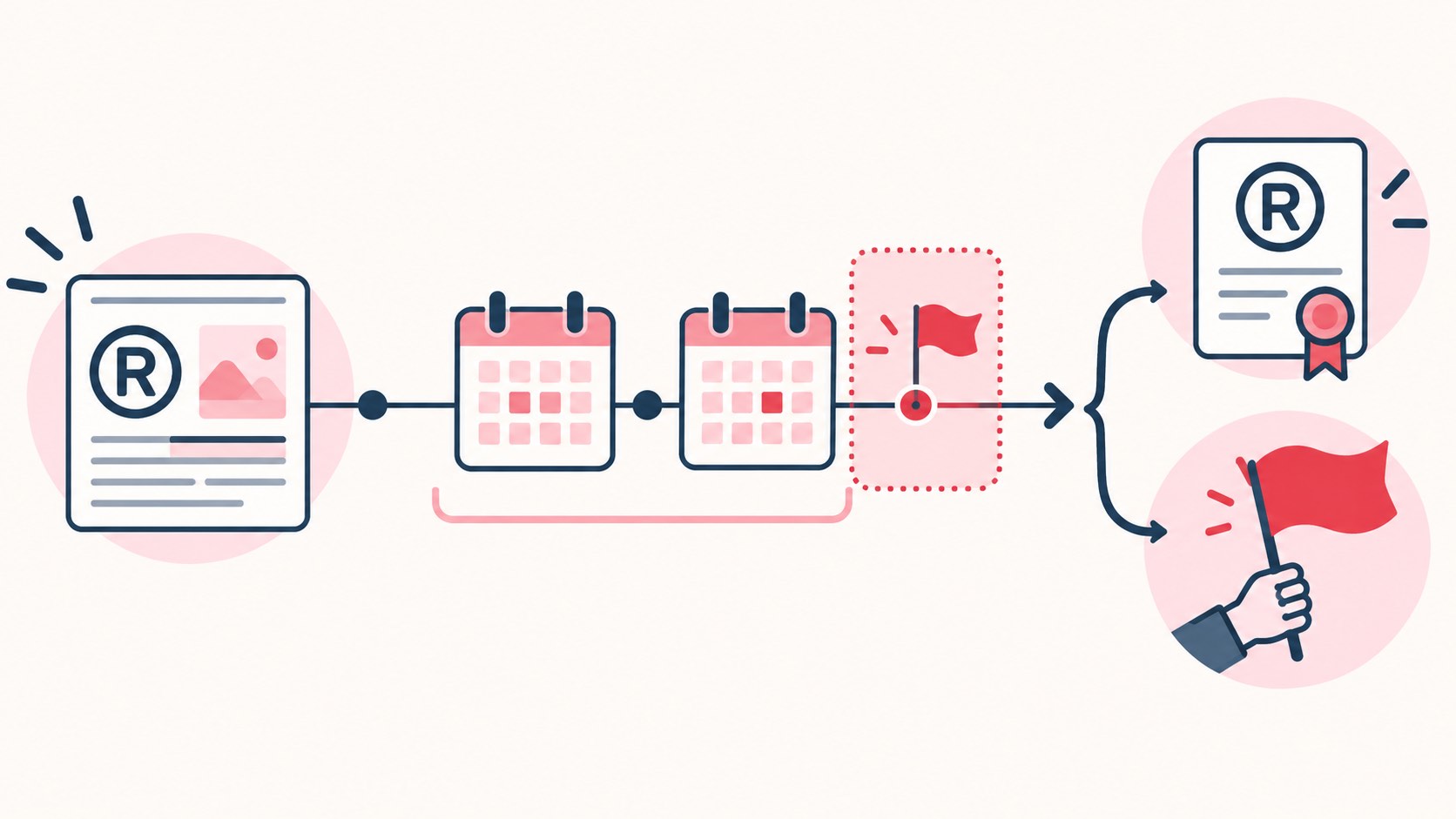
A TM7A notice of threatened opposition is a form that someone files with the UK Intellectual Property Office (IPO) when they are thinking about opposing your trademark application but have not decided yet. Filing it gives them one extra month to make up their mind, so their window to oppose runs for three months after your application is published instead of two. It is not an opposition in itself, there is no official fee to file it, and it does not commit them to anything.
If one has been filed against your application, the practical effect is that your registration is held back by up to a month, and what you do in that month matters more than the form itself. Below I have set out each stage of the UK opposition timeline with the time it usually takes, so you know where you stand and what comes next.
Why is my trademark taking longer to register than expected?
One possible reason is a TM7A: someone has asked for an extra month to decide whether to oppose. We posted a short note on The Trademark Helpline’s LinkedIn page about this exact situation. It is easy to expect registration to follow neatly after the two-month opposition period, then find the application still waiting a month later. The advice in that post is simple: do not panic, and do not ignore it.
The word “threatened” sounds hostile, which is understandably unsettling. The IPO’s own Tribunal Section manual describes the TM7A as, in effect, a request for an extension of time.
What does a TM7A notice of threatened opposition actually do?
It gives the person who files it one extra month to decide whether to oppose, and nothing more. When the IPO accepts an application, it publishes it in its online journal, which is the public list of applications waiting to be registered. Publication starts the opposition period, the window in which anyone who objects can formally challenge the application. That challenge, and the defence to it, is the work our trademark opposition service handles, from the forms through to the evidence. Here is what the TM7A changes, taken from rule 17 of the UK trademark rules and the IPO’s guidance:
- It is filed online only, and it has to be filed within the first two months after publication.
- There is no official fee for it.
- It extends the deadline to three months, but only for the person who filed it (or, for a company, other companies in the same group). Anyone else still has just the original two months, and the IPO refunds a formal opposition filed in the third month by someone who had not filed a TM7A.
- It cannot be stretched further. The three-month limit is fixed, so by the end of month three you will know whether a formal opposition is coming.
- It is not a commitment. The IPO’s opposition guidance says filing one does not commit anyone to opposing, although it asks people not to file one unless they are seriously considering it.
How long does the trademark opposition process take in the UK?
The opposition window is two months, a TM7A adds one more, and a defended opposition usually takes well over a year to reach a decision. These are the published periods from GOV.UK and the IPO manual. Real dates depend on when forms are filed and served, so treat them as a guide.
Stage 1: examination, about 2 to 3 weeks
After you file, the IPO examines the application and sends an examination report, usually within 2 to 3 weeks. If it raises objections, meaning reasons the mark may not be registrable, you have 2 months to resolve them.
Stage 2: publication, 2 months
Once the application is accepted it is published, and the two-month opposition period begins immediately after the publication date. If nobody files anything, GOV.UK says the mark is usually registered around 10 weeks after publication.
Stage 3: the notice of threatened opposition, 1 extra month
If someone files a TM7A during those two months, their deadline moves to three months after publication. Your application cannot be registered until that month has run out.
Stage 4: registration, or a formal opposition
If the person who filed the TM7A does nothing by the end of month three, the application carries on to registration. If they do decide to oppose, they file a Form TM7, the formal notice of opposition, which sets out their grounds, meaning the legal reasons they give for refusing your mark.
Stage 5: your defence, 2 months
The IPO checks the TM7 and sends it to you. The date it is sent is called the notification date, and from then you have 2 months to file a Form TM8, your notice of defence and counter-statement (your written answer to their grounds). There is no official fee for the TM8. If no defence is filed, the application is treated as abandoned for the goods or services that were opposed, so this is the deadline I would watch most closely.
Stage 6: cooling off, 9 to 18 months
If both sides would rather talk than fight, either can file a Form TM9C within those 2 months to start a cooling-off period. This gives 9 months from the notification date to negotiate, and it can be extended once, with a Form TM9E, to a maximum of 18 months. If talks break down and the opponent ends cooling off, the applicant then has 1 month to file the defence.
Stage 7: evidence and a decision, often well over a year
Once a defence is in, the IPO sets a timetable for each side to file evidence and written arguments. Its own published estimates, as checked in September 2026, put a decision made on the papers at around 20 months from the opposition being filed, and around 37 months where there is a hearing. Those figures leave out any cooling-off period.
What can you do if someone files a TM7A against your application?
A sensible first step with any TM7A is to answer three questions: who filed it, what earlier marks or rights they hold, and which goods or services in the application are likely to concern them. Those answers shape which of these options makes sense.
- Find out who it is. The UK register is public, so their earlier marks and the goods and services they cover can be checked.
- Talk to them. The IPO’s guidance suggests contacting the party who filed the TM7A to see whether things can be settled amicably. The IPO also runs a mediation service for disputes like this.
- Narrow the application. Often the concern is only part of the list of goods and services, called the specification. You can remove or limit terms using Form TM21B, which has no official fee, and the examiner will confirm whether the change is acceptable.
- Withdraw, if it genuinely is not worth defending. If you withdraw before a formal opposition is filed, the IPO’s guidance says you will not be liable for their costs.
- Wait and prepare. If none of the above fits, it is worth using the month to gather dated evidence of how you use your mark, so you are not starting from scratch if a TM7 arrives.
The one option I would never recommend is ignoring it. A TM7A on its own cannot stop your registration, but a TM7 that goes unanswered can.
What does a TM7A mean for a small business?
A notice of threatened opposition is a signal rather than a verdict: someone with a possible interest has noticed your application and wants time to think. A TM7A does not have to lead to an opposition, and where there is a genuine overlap, a conversation and a tidier specification can sometimes settle it before anything formal is filed. Larger brands do watch the register, and our piece on how Gymshark blocked a lookalike application called GymBull shows what that can look like.
Timing is the part worth planning for. If you are planning a launch, a rebrand or an investment round around the date you expect your trademark to register, a TM7A can push that back by a month, and a formal opposition can push it back by a year or more. I would build that possibility into any plan that depends on the registration certificate arriving on a set date.
A UK trademark covers the UK and the Isle of Man only. If you have also filed in other countries, each office has its own opposition rules and timings.
How can we help with a TM7A?
At The Trademark Helpline I draft and file applications and research and gather the evidence behind opposition cases. If a TM7A or a TM7 has been filed against your application, we can look at who is behind it, what they hold, and whether a narrower specification, a negotiated agreement or a full defence is the sensible route. Our guide to the opposition period explains where that stage sits in the wider process. When we are named as your representative through our trademark representation and protection service, IPO letters like these come to us first, and we tell you what each one means and when it needs an answer.
The best time to reduce the chance of an opposition is before you file. Only the owner of an earlier mark or right can oppose on relative grounds, meaning a clash with an existing brand, and earlier marks are exactly what a search looks for. A trademark consultation and clearance audit before filing checks for those earlier rights and gives a view on how likely an opposition is. Start with a free trademark search on your name, logo or tagline, and if a notice has already landed, book a free call, ring us on 0161 833 5400 or email enquiries@thetrademarkhelpline.com and we will talk you through the next steps.
Related questions
- Can I register a trademark myself, or do I need an attorney?
- Someone is already using my business name. What can I do?
- I got a trademark renewal letter or invoice. Is it a scam?
- When should I trademark, before or after I launch?
This article is for information purposes only and does not constitute trademark advice or guidance. Last reviewed 25 September 2026. First shared as a LinkedIn post.
Questions about this
What is a TM7A notice of threatened opposition?
It is a form filed with the UK IPO by someone considering opposing your trademark application who has not yet decided. It is filed online within two months of publication, has no official fee, and extends that person’s deadline to oppose from two months to three. It is not an opposition and does not commit them to anything, although the IPO asks people to file one only if they are seriously considering opposing.
 Answered by Laura Spencer, Paralegal
Does a TM7A delay my trademark registration?
Yes, by up to a month. Your application cannot be registered until the extended three-month window has run out. If the person who filed the TM7A does nothing by then, the application carries on to registration. If they decide to oppose, they file a Form TM7 setting out their grounds, and you then have two months from the notification date to file a defence on Form TM8.
Answered by Laura Spencer, ParalegalWhat can I do if someone files a TM7A against my application?
Start by working out who filed it, which earlier marks or rights they hold, and which goods or services in your application are likely to concern them. The register is public, so their marks can be checked. The IPO suggests contacting them to see whether matters can be settled, and it runs a mediation service. Narrowing your specification with Form TM21B, which has no official fee, often resolves the concern.
Answered by Laura Spencer, Paralegal