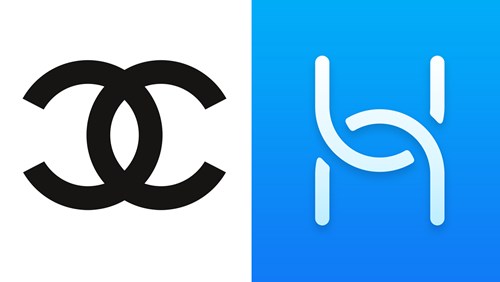
The first thing you think of when someone say’s ‘brand identity’ is the logo, just like the first thing you think of when someone says ‘Chanel’ are its world famous and instantly recognisable interlinking semi-circles.
Well last week saw French luxury fashion house Chanel lose its European court fight against Chinese technology giant Huawei over their bid to use interlocking semi-circles in their mark.
The dispute dates back as far as 2017, when Huawei first tried to register its computer hardware trademark, a design consisting of two interlocking semi-circles in a vertical position. Chanel objected to the application, claiming that if you flipped Huawei’s design on its side, it was similar to their registered logo.
In 2019, the EU Intellectual Property Office (EUIPO) dismissed Chanel’s objection saying that there wasn’t a similarity and there was no likelihood of confusion between the two.
Chanel didn’t settle for this however and took their appeal to the Luxembourg-based General Court. Their appeal was dismissed with the tribunal of judges ruling that “The figurative marks at issue are not similar. The marks must be compared as applied for and registered, without altering their orientation. The visual differences in the two logos were significant. In particular, Chanel’s marks have more rounded curves, thicker lines and a horizontal orientation, whereas the orientation of the Huawei mark is vertical. Consequently, the General Court concludes that the marks are different,”
We will be watching with interest to see if Chanel takes it’s last shot at appealing this ruling, by taking it to the EU Court of Justice, the highest in Europe.
Questions about this
What did the EU General Court decide in Chanel v Huawei?
The General Court dismissed Chanel’s appeal against Huawei’s application to register a logo of two interlocking semi-circles for computer hardware. It ruled that the marks were not similar, noting that Chanel’s marks have more rounded curves, thicker lines and a horizontal orientation, while Huawei’s mark is vertical. The EUIPO had already dismissed Chanel’s objection in 2019, finding no similarity and no likelihood of confusion.
 Answered by Jonathan Paton, Founder & CEO
Are logos rotated or flipped when compared in a trademark dispute?
No. In the Chanel and Huawei case, Chanel argued that Huawei’s design looked like its own logo when turned on its side, but the court held that marks must be compared as applied for and registered, without altering their orientation. Visual differences such as line thickness, curves and orientation all count. It is a useful reminder that similarity is judged on the marks as they actually appear on the register.
Answered by Jonathan Paton, Founder & CEOCan I object to a trademark application that looks like my logo?
Yes. If someone applies to register a mark you believe is too close to yours, you can oppose it during the publication window, which in the UK is two months. The outcome depends on whether the marks are similar and whether there is a likelihood of confusion, judged on the marks as filed. Even a famous brand will not succeed if the logos are found to be visually different.
Answered by Jonathan Paton, Founder & CEO