One of our clients has received a new trademark scam email from a business calling itself Trademarks Filers.
The email claimed that another organisation was trying to register the client’s brand name and that the client had a limited window to act before they lost their position.
This is the typical fear-based scam, it creates urgency, uses legal sounding language, and makes the recipient feel like they need to respond before they have time to think.
Thankfully, our client sent it to us first.
The main warning signs
There were a few things that stood out immediately.
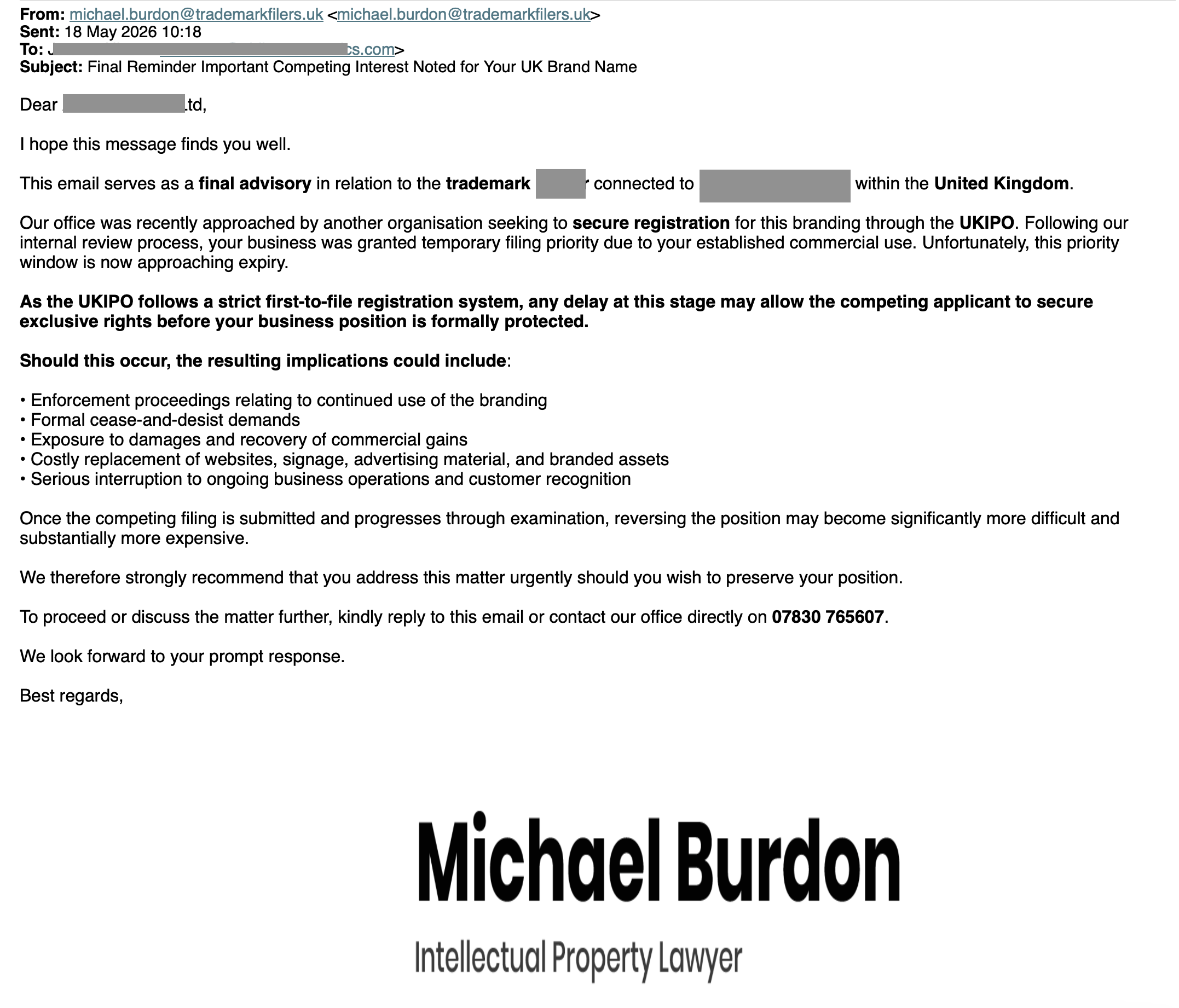
The email used two different domain names. The sender address used trademarkfilers.uk, while the signature referred to trademarksfilers.co.uk.
That may sound small, but a genuine professional firm would not usually send emails from one domain and then use a different one in the footer.
The email also claimed the client had been given a “temporary filing priority” because of their existing use of the brand name.
That is not how UK trademarks work.
A private company or filing agent cannot grant you a priority window. The UKIPO deals with trademark applications. No third party gets to reserve your position or give you a final chance before someone else files.
Trademarks Filers Email Below
A redacted version of the trademark fillers email is set out below for your review.
The website does not hold up
The Trademarks Filers website looks convincing at first glance, but the detail is wrong.
It uses American wording such as federal trademark registration, federal e filing and all states searches. Those terms do not fit the UK trademark system.
The UK does not have federal trademarks or state trademark searches.
The site also appears to use generic testimonials, legal sounding wording and buttons that do not seem to do anything useful.
In short, it looks like a website built to create confidence, not a genuine UK trademark practice.
Trademark Genius appears to be connected
The investigation also found another site called Trademark Genius or Trademarks Genius.
It appears to use the same type of template. Some wording even seems to refer to another name, Trademark Official Notice, which suggests the same template may have been reused across different scam websites.
That is the bigger issue here.
This does not look like one questionable email. It looks like part of a wider pattern where similar websites and similar wording are being reused under different names.
A real solicitor’s name, Michael Burdon, has been misused
This part is important.
The email used the name Michael Burdon. Michael Burdon is a real solicitor. That does not mean he sent the email. It does not mean he is involved.
It appears that his name has been misused to make the email look more credible.
The Solicitors Regulation Authority has already published a warning about emails misusing the name of Michael Burdon. The SRA confirms that it authorises and regulates a genuine solicitor called Michael Burdon, and that Michael Burdon has confirmed he has no connection to the emails referred to in that warning.
You can read the official SRA warning here:
https://www.sra.org.uk/consumers/scam-alerts/2025/apr/michael-burdon/
This is a common scam tactic. If the recipient searches the name and finds a real solicitor, they may assume the email is genuine.
In reality, the solicitor may also be a victim of the scam.
This is a scam ring, not a one-off
What became clear from our research is that this is not one scammer doing one bad thing.
It appears to be part of a wider, ongoing operation that has been running new versions of the same trademark scam for over a year.
The basic script is usually the same:
- Someone has approached us seeking to register your name
- The Trade Marks Act 1994 requires us to give you notice
- You need to act urgently or you will lose your rights
- We can file the application on your behalf
The only thing that changes is the name on the door.
Examples of related SRA scam alerts include:
- Solicitors Ballard and Trademark Expressive
- Wozi Law Firm, using the name of Michael Burdon
- Tai He Law Firm, using the name of Michael Burdon
- Trademark correspondence using the name of Christopher Aide
- CSS Law Ltd
- Cross Legal Services and Isabella Dunk
- Thornhill Legal Ltd
- Rahman Legal Services Limited
That is why this matters. These scams are not always badly written emails from nowhere. Some of them use real names, polished websites and official sounding language.
As soon as one version is reported, another one can appear under a new name.
It is easier to build a fake law firm website than it is to get one taken down, and the people behind these operations know that very well.
What we are doing about this one
We will be reporting the Trademarks Filers email to the appropriate places.
First, the Solicitors Regulation Authority. The SRA already publishes scam alerts for this type of correspondence, and this appears to be another version of the same pattern.
Second, the suspicious domains should be reported through the National Cyber Security Centre by forwarding the email to:
This allows the NCSC to assess the email and, where appropriate, support action against phishing domains.
Anyone who has received one of these emails can also report it to Action Fraud.
The more reports these scams receive, the easier it becomes for the authorities and domain providers to see the pattern.
Why are you being targeted?
We don’t know exactly how the senders of these letters choose who to write to. From the ones forwarded to us, they tend to pick businesses that:
- are established and have been trading for a while
- have a strong name, logo or tagline that customers know them by
- have not registered a trademark
They know you should have one. They are counting on a moment of panic, when paying them feels quicker than finding a legitimate adviser. The people who have told us they paid after a letter like this rarely received anything for their money.
How did the letter make you feel?
If it worried you, take that seriously. However badly meant, the letter has put its finger on something real: your brand may not be protected, and a registered trademark is the best way to protect it.
Ask yourself what it would cost if you had to stop using your name tomorrow and rebrand: the signage, the website, the packaging, the stationery, and the years of reputation built under that name.
Can you register your name?
Not always, which is why we check first. A trademark is not guaranteed. Your name has to be distinctive enough in your sector, and however long you have been trading, someone else may already own a trademark for it without you having felt the consequences yet.
That is why we always start with a free trademark search, followed by a Trademark Clearance Audit and consultation, so we can assess everything and flag any threats before you spend anything on official fees.
Trademarks are not just for big companies
They are not expensive: the UKIPO’s own fee for a UK trademark starts at £205 for ten years of protection, for one class, applied for online. And they are not a cost. A registered trademark is a business asset in its own right. For more detailed pricing, try our trademark cost calculator.
The key is keeping a regular watch on the trademark registers, Companies House, social media, marketplaces and even search engines. The real law firms named in some of these warnings have had strangers trading on the reputation and goodwill they built. The sooner you spot an infringement, the sooner you can have it taken down, and the less damage it can do to your brand. That is what TMH Monitoring does.
Find out where your name stands
We don’t condone the senders of these letters or their tactics, but we know who they pick: established businesses that haven’t registered a trademark. Trademarks are often overlooked by UK brands, yet a registration is the essential tool for getting malicious websites and confusingly similar social media accounts taken down.
We have just seen it work. A copycat law firm website we warned about was taken offline less than a day after we listed it. That is the value of proactive brand protection.
Start with a free search of the UK trademark register. It shows whether similar names are already registered, and a specialist will talk you through what it means for your business.
What you should do if you receive one
If you receive an email like this, the rules are simple:
- Do not reply
- Do not call the number
- Do not click any links
- Do not make a payment
- Do not panic
- Do not ignore it completely
If we are your representative, forward it to us and we will check it.
If we are not your representative but you would like a second opinion, you can still send it to us at enquiries@thetrademarkhelpline.com and we will take a quick look.
We do not charge for that.
What you can do to protect against scams
We are now seeing more trademark scams, and they are getting more convincing.
The volume has increased, and the polish of the emails and websites has increased with it. AI has made it easier than ever for scammers to produce something that looks credible at a glance.
The single most important rule is this:
Do not respond to trademark related correspondence, by post or email, without checking it first.
If we represent you, send it to us.
If someone else represents you, ask them.
If nobody represents you, that itself may be worth a conversation.
Email scams: is your email security up to date?
Trademark scams are not the only risk. Most businesses are also dealing with phishing emails, fake invoices, supplier impersonation, CEO fraud and other inbox based scams.
We have always paid for professional email security, but one of our IT support clients recently spotted gaps in our own setup. It took them less than 30 seconds to provide a report showing what needed to change.
These types of measures can help protect you from scams and impersonators before they reach the people in your business.
If you would like a free audit of your email security, email enquiries@thetrademarkhelpline.com with:
- Your email address
- Your domain names
- Any other domains your business uses for email
We will run the test for you and let you know what it finds.
Final thought
If something feels off, it usually is.
But with trademarks, the danger is that not every worrying letter or email is fake. Sometimes there really is a deadline. Sometimes there really is an opposition. Sometimes there really is an issue that needs dealing with quickly.
That is why the answer is not to ignore everything.
The answer is to check before you act.
If you have received an email from Trademarks Filers, Trademark Genius, Trademark Official Notice or any similar trademark service, send it to us before doing anything else.
Email enquiries@thetrademarkhelpline.com or call 0161 833 5400 between 9am and 6pm, Monday to Friday.
Questions about this
Can a filing agent give my business a temporary priority window on a trademark?
No. A private company or filing agent cannot grant a priority window or reserve your position. Trademark applications in the UK are dealt with by the UKIPO, and no third party can give you a final chance before someone else files. An email claiming you have temporary filing priority because of your existing use of a name is a warning sign, and it is worth having it checked before replying, clicking links or paying anything.
 Answered by Jonathan Paton, Founder & CEO
What should I do if I get an email saying someone is trying to register my brand name?
Do not reply, call the number, click any links or make a payment, but do not ignore it completely either. Forward it to your trademark representative to check. If we are not your representative, you can still send it to us for a free second opinion. Suspicious emails can also be forwarded to report@phishing.gov.uk so the National Cyber Security Centre can assess them, and reported to Action Fraud.
Answered by Jonathan Paton, Founder & CEOWhy do some trademark scam emails use the name of a real solicitor?
Because it makes the email look credible. If a recipient searches the name and finds a genuine, regulated solicitor, they may assume the email is real. In reality the solicitor may have no connection to it and may also be a victim. The Solicitors Regulation Authority publishes scam alerts where names have been misused, so checking those alerts, and having your representative review the email, is a sensible first step.
Answered by Jonathan Paton, Founder & CEO