One of the benefits of having a client base of over 4,000 and a newsletter list of 18,000 subscribers, across pretty much every sector you can think of, is that we get to hear about scams almost in real time. WIPOT is one of them. And it’s one of the more devious ones doing the rounds at the moment.
WIPOT stands for “World Intellectual Property Office for Trademarks” which, if you’ll forgive me stating the obvious, sounds an awful lot like WIPO, the actual World Intellectual Property Organization in Geneva. That isn’t an accident.
The name has been chosen very carefully to be confused with a real, legitimate, internationally respected body. And it works. Because if you’ve just filed a UK trademark application, the last thing you expect is to receive an invoice from somebody you’ve never heard of, referencing your exact trademark, your exact application number, and your exact filing date.
What this is in plain English: a misleading invoice. WIPOT is on the UK Intellectual Property Office’s official list of unsolicited mail companies, and the IPO’s advice couldn’t be clearer… do not pay it.
The story
A client of ours forwarded one over to us a few weeks back. They’d applied for their trademark only a month earlier, and the letter looked official enough at first glance, clean layout, formal letterhead, the lot. It demanded a few hundred euros for “publication” or “registration” in what it described as an international register. The fine print mentioned that this is in fact a private database. The bigger print did everything it could to look like a government invoice.
Fortunately, they did the right thing, they didn’t pay, and they picked up the phone to us. Something I’m genuinely grateful for is that we’re present enough with our clients that they know to bring things like this to us before they get caught.
But here’s where I want to be honest with you for a minute, before we get into the details.
A note before we go on
Whilst I’ve never been a great judge when it comes to personal relationships, as somebody who’s worked in legal and financial services since 2008, I’ve generally been pretty good at spotting a high-volume scam. However, some of the sharpest people I know get caught out by something like this, that looks familiar, official, or trusted.
It’s not your fault
What I have witnessed first hand from a career involving legal claims around professional negligence, breach of fiduciary duty and straightforward negligence, is the same pattern again and again. When people fall victim to any of those things, their natural response isn’t anger. It isn’t to blame. It’s self-deprecation and shame. They feel stupid. They go quiet. They tell nobody.
This has to stop.
If you’ve paid one of these scammers, you’re not stupid. The whole machinery is designed by people who do this for a living and have refined their craft over years. They use your real trademark data, which sits on the public UK trademark register, and they wrap it in official-looking design. Falling for it isn’t a character flaw. It’s a sign that the scammers are doing their job well, and that the rest of us need to talk about it more openly so the next person spots it before they pay.
Right. Back to WIPOT.
What a WIPOT letter looks like
The letters and emails vary slightly each time, but the pattern is consistent:
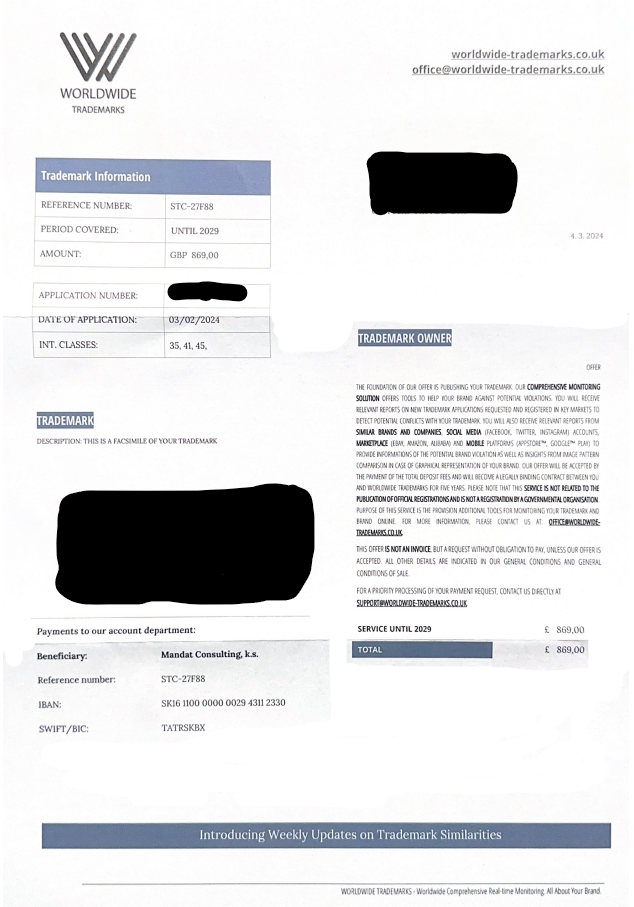
– The name “WIPOT” or “World Intellectual Property Office for Trademarks” appears prominently at the top, often with a logo featuring globes, scales of justice or other “official-looking” iconography
– Your actual trademark details are quoted accurately – name, application number, filing date, classes
– An invoice amount in euros (typically a few hundred to over a thousand) is requested for “publication”, “international register entry” or “extended protection”
– A short payment deadline is given, creating urgency
– The bank account for payment is almost always outside the UK
– Buried in the fine print, often in tiny grey text, is a disclaimer that this is a private commercial offer and not connected to any government body
That last point is the legal cover the scammers rely on. They argue they aren’t lying because they did tell you, technically, on line 47 of the small print. The Advertising Standards Authority
and the courts have repeatedly disagreed with that defence – but usually only after the money is gone.
This is how the original letter appears (client information has been redacted for privacy)
Why it’s a scam (the giveaways)
A few quick tells you can use in seconds:
– The real UK IPO does not send invoices in euros to foreign bank accounts. All official IPO fees are sterling and paid via gov.uk
– A UK trademark renewal costs £200 for one class through the official IPO renewal service, not several hundred euros
– You don’t need to be in an “international register” to have your UK trademark protected. UK registration is what protects you in the UK, full stop. International protection is something entirely separate, and it never starts with a cold invoice from a name you don’t recognise
– No legitimate government body demands payment within 7 or 14 days for something where nothing material happens if you don’t pay
– If you have a trademark attorney, all official correspondence goes through them — not directly to you. If something has bypassed your attorney, that on its own is a red flag
What to do if you’ve received a WIPOT letter or email
- Don’t pay it. It is highly unlikely you’d see that money again. These outfits operate across borders, which makes recovery extremely difficult.
- Forward it to the IPO at misleadinginvoices@ipo.gov.uk. They genuinely want to see these — it’s how they keep their official watch list current.
- Report it to Action Fraud, the police-run fraud reporting service.
- Tell your local trading standards office. You can find yours via gov.uk.
- Send it to us. Either email enquiries@thetrademarkhelpline.com or book a free 15-minute call. We’ll tell you within minutes whether it’s genuine. No charge, no upsell, no obligation.
What to do if you’ve already paid
First, and most importantly, please, don’t beat yourself up. Go back and read the note above. Then:
– Contact your bank immediately and tell them the payment was made to a misleading invoice. Depending on how recently you paid and how, they may be able to recall the transaction or arrange a chargeback
– Report it to Action Fraud
– Forward the invoice to the IPO so it strengthens their evidence base
– Get in touch with us. We’ll walk you through what’s actually protected, what isn’t, and whether there’s anything practical we can do on the trademark itself
The money may be gone. But your trademark is still yours, and there will be a clear path forward.
One last thing
If you’ve landed on this article because a letter from WIPOT just appeared on your desk, well done for checking before paying. That’s almost the single best thing you can do, and most people don’t. The next best thing you can do is forward it to us if you want a second pair of eyes. That’s literally what we’re here for.
And the best thing you can do, is click to share this article with your network and help protect other people like you.
The biggest weapon against these scams isn’t enforcement. It’s awareness.
And if having read this, you feel like you may benefit from affordable professional help relating to a trademark, book a free initial consultation or email us to see if we can be of service.