
Over the years, we have reported on a growing number of trademark scams targeting UK businesses.
One that continues to circulate heavily is the OMPS trademark letter scam.
Unlike some of the more aggressive “legal notice” style scams we have written about previously, the OMPS letter is designed to look more like an official publication or directory invoice connected to your trademark application.
At first glance, it can appear genuine.
The layout looks professional. It references your trademark details correctly. It includes your trademark number, filing date and classes. The design itself even resembles official Companies House style correspondence. For a busy business owner, it can easily look like a legitimate invoice connected to the UK Intellectual Property Office.
Unfortunately, that is exactly the point.
We still regularly receive these letters for clients, even when we act as their representative and use our care of address service. They essentially throw mud at the wall and see what sticks and, given this scam has been circulating for years, people are unfortunately still paying it.
The OMPS Letter
One of the latest examples we received can be seen below. Client information has been removed for privacy reasons.
—OMPS
TRADEMARK PUBLICATION
YOUR NAME
YOUR ADDRESS LINE 1
YOUR ADDRESS LINE 2
YOUR POSTCODE
United Kingdom
Application Number: UK0000XXXXXXX
Application Date: XX/XX/2026
Class(es): XX, XX
REPRODUCTION OF TRADEMARK
YOUR TRADEMARK
Publication Fee: £985.00 GBP
“The publication of the public registration of your trademark serves as the foundation of our offer. We provide a comprehensive online service aimed at showcasing your brand, increasing its visibility, and building awareness. Your trademark will be published in our private database at [www.ompsregister.com](http://www.ompsregister.com), and we will draft a professionally written article that highlights your company’s achievements, accomplishments, and brand journey. This article will be tailored to emphasize your successes, thereby enhancing your reputation and online presence.
Please note that this service is not related to the publication of official trademark registrations, nor is it a registration with any governmental organization and we do not currently have a business relationship. By signing this agreement and returning it to us, you agree to enter into a binding contract for a one-year period.”
—
This is how the original letter appears (client information has been redacted for privacy)
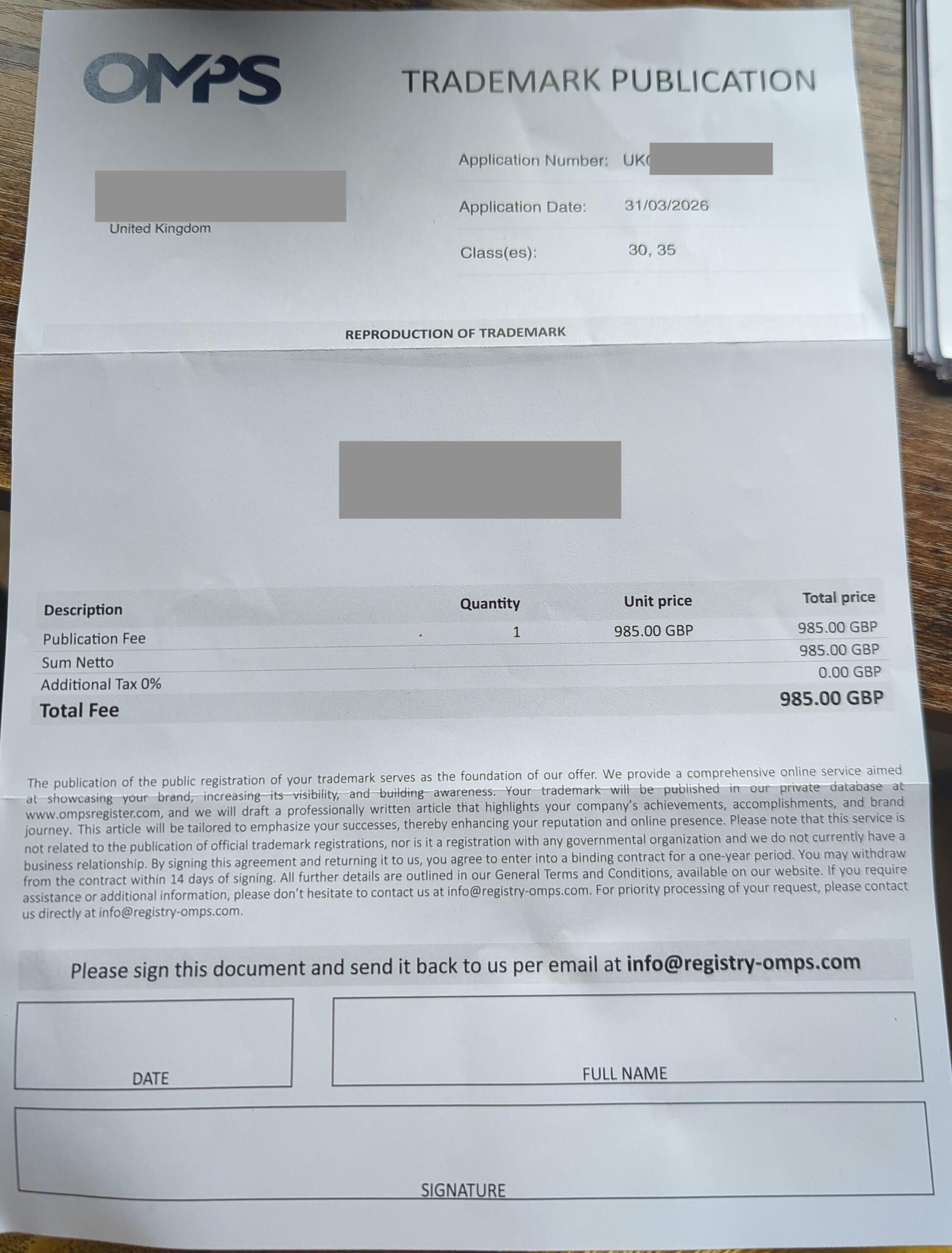
The letter references:
- A real UK trademark application number
- The correct filing date
- The relevant trademark classes
- A “publication fee” of £985
It also uses wording such as:
“Trademark Publication” and references publication services designed to increase the visibility of your trademark.
To somebody unfamiliar with the trademark process, it can easily appear to be:
- An official publication requirement
- A mandatory trademark fee
- A UKIPO connected service
- Or something legally important that requires immediate payment
This is where many business owners get caught out.
What is actually happening?
The important thing to understand is this:
This is not an official EU or UKIPO fee, the UKIPO does not issue invoices like this for “publication fees” after your application has been filed.
Instead, these letters are generally offering inclusion within a private commercial database or publication service which most businesses neither need nor realise they are signing up for.
In our experience, the £985 fee delivers little to no meaningful value to businesses. It is our understanding that payments are routed to a Swiss company and, once paid, the money is generally unrecoverable.
The small print is usually where the real detail sits.
Buried within the wording are important disclaimers such as:
- “Not related to the publication of official trademark registrations”
- “Not a registration with any governmental organization”
- “Binding contract for a one-year period”
The problem is that many business owners understandably lack the time to read every line of small print when the overall presentation strongly resembles an official trademark notice.
Why are you receiving these letters?
Because trademark registers are public.
Once a trademark application is filed, certain information becomes publicly accessible, including:
- Trademark numbers
- Applicant names
- Filing dates
- Correspondence details
- Goods and services classes
Scam operators monitor these registers constantly.
Once your trademark reaches certain stages, particularly publication, they send letters designed to appear connected to the process.
This is one of the reasons why many businesses choose to use professional representatives and care of address services.
How to spot a trademark scam letter
While scams are becoming increasingly sophisticated, there are usually warning signs.
1. It looks official
These letters are specifically designed to imitate official correspondence.
In this example:
- It references a genuine trademark application number
- The formatting resembles Companies House style documents
- It includes real filing dates and classes
- It uses formal trademark terminology
For somebody unfamiliar with trademark procedure, it can appear entirely legitimate.
2. The fees are unusually high
In this example, the requested fee was £985 for a publication service most businesses would never intentionally purchase.
3. The small print tells a very different story
The key wording is often buried lower down the document:
- “Private database”
- “Not affiliated with government”
- “Advertising service”
- “One year contract”
4. The timing is deliberate
These letters often arrive shortly after publication because businesses are already expecting trademark related correspondence.
That timing is not accidental.
Important: do not ignore trademark correspondence entirely
This is extremely important.
Even though letters like this raise concerns, you should never simply ignore all trademark related correspondence.
Sometimes there are genuine:
- oppositions
- examination issues
- deadlines
- legal disputes
- third party conflicts
The difficulty for many SME business owners is knowing which letters matter and which do not.
That problem is becoming even harder as AI allows scams to become more convincing and professional looking.
This is one of the reasons businesses use representatives
A large part of our role is simply helping clients filter the noise.
When clients use our care of address and representation service:
- Trademark related correspondence comes through us first
- Scam letters are identified quickly
- Misleading notices are filtered out
- Genuine issues are escalated properly
- Clients avoid unnecessary panic and distraction
In reality, most business owners should not be spending time trying to work out whether every trademark letter is genuine.
That is part of what professional representation is there for.
And yes, even with our care of address service in place, these scam letters still arrive for clients from time to time. The difference is they normally go straight in the shredder before the client ever has to worry about them.
What should you do if you receive one?
If you receive an OMPS Scam letter or any similar trademark scam communication:
- Do not panic
- Do not make immediate payment
- Do not sign anything
- Do not ignore it completely
- Get it checked properly
If in doubt, send it to somebody who deals with trademarks every day.
Final thought
Unfortunately, trademark scams are now part of the reality of operating on public registers.
The combination of:
- public data
- AI generated communications
- legal sounding wording
- convincing branding
- professional looking designs
means these scams are becoming harder for ordinary businesses to identify.
That is exactly why experienced representation matters.
If you receive a trademark letter and are unsure whether it is genuine, feel free to contact our team and we will happily take a quick look and point you in the right direction.
As always, we are more than happy to help.
Questions about this
Is a ‘Trademark Publication’ letter asking for a £985 fee from the UKIPO?
No. The UK Intellectual Property Office does not issue invoices for ‘publication fees’ after an application has been filed. Letters of this kind generally offer inclusion in a private commercial database or publicity service, and the small print says the service is not related to official trademark publication, is not a registration with any government body, and becomes a binding one-year contract once signed and returned.
 Answered by Jonathan Paton, Founder & CEO
Why do I receive trademark letters soon after filing an application?
Because trademark registers are public. Once an application is filed, details such as the trademark number, applicant name, filing date, correspondence details and classes can be seen by anyone. Third parties monitor the registers and time letters to look connected to the process, often around publication. Using a representative with a care of address service can reduce this mail, although it does not stop it entirely.
Answered by Jonathan Paton, Founder & CEOWhat warning signs suggest a trademark letter is not official?
Common signs include formatting that imitates official correspondence while quoting your real application number, dates and classes; an unusually high fee; small print mentioning a private database, no government affiliation or a one-year contract; and timing that coincides with publication. It is still worth reading all trademark correspondence, since genuine oppositions and deadlines do arrive. Suspicious invoices can be reported to misleadinginvoices@ipo.gov.uk.
Answered by Jonathan Paton, Founder & CEO