We are continuing to see trademark applicants being targeted by publication style letters that look official, use real trademark details and request payment for what appears to be a private listing service.
The latest Trademark scam letter example we have seen is from a company calling itself VPS, WPS, or TPS.
This follows the same pattern as the OMPS and TMP trademark publication letters we have covered previously. The name changes, the branding changes, but the structure is almost identical.
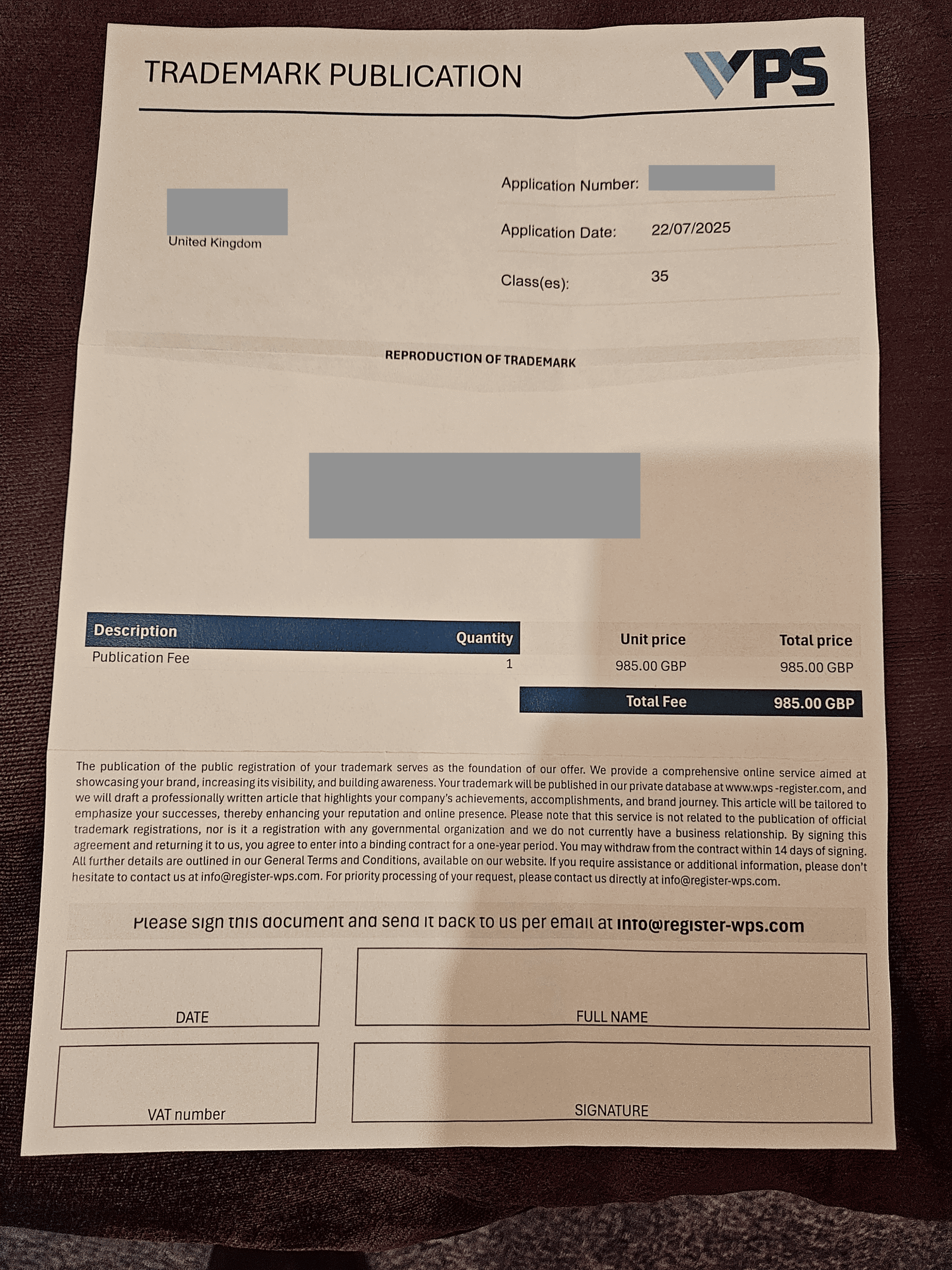
A formal looking document arrives in the post. It references your trademark application number, your application date, your trademark classes and the name of your trademark. It then asks for a “Publication Fee”.
In this VPS example, the fee is £985.
For a business owner who has recently filed a trademark application, this can be very easy to misunderstand.
The letter looks connected to the trademark process.
It is not.
Why the VPS letter can look genuine
This type of letter works because it uses information that is already publicly available from trademark registers.
It may include:
• Your name or business name
• Your address
• Your trademark application number
• Your application date
• Your trademark classes
• The wording of your trademark
• A formal fee table
• A request to sign and return the document
The design also makes it look more important than it is. The words “Trademark Publication” appear prominently at the top, the document is laid out like an official invoice and the fee is presented in a way that could make it look like a necessary trademark cost.
That is the danger.
It does not need to directly say “UKIPO” to create the impression that it is connected to the official trademark process.
The VPS letter or it could be from WPS or TPS
A redacted version of the VPS Trademark Scam letter is set out below, with the personal and trademark details replaced by placeholders.
—
VPSTRADEMARK PUBLICATION
YOUR NAME
YOUR ADDRESS LINE 1
YOUR ADDRESS LINE 2
YOUR POSTCODE
United Kingdom
Application Number: YOUR TRADEMARK APPLICATION NUMBER
Application Date: XX/XX/XXXX
Class(es): XX
REPRODUCTION OF TRADEMARK
YOUR TRADEMARK NAME
Description: Publication Fee
Quantity: 1
Unit price: 985.00 GBP
Total price: 985.00 GBP
Total Fee: 985.00 GBP
“The publication of the public registration of your trademark serves as the foundation of our offer. We provide a comprehensive online service aimed at showcasing your brand, increasing its visibility, and building awareness. Your trademark will be published in our private database at [www.vps-register.com](http://www.vps-register.com), and we will draft a professionally written article that highlights your company’s achievements, accomplishments, and brand journey. This article will be tailored to emphasize your successes, thereby enhancing your reputation and online presence. Please note that this service is not related to the publication of official trademark registrations, nor is it a registration with any governmental organization and we do not currently have a business relationship. By signing this agreement and returning it to us, you agree to enter into a binding contract for a one-year period. You may withdraw from the contract within 14 days of signing. All further details are outlined in our General Terms and Conditions, available on our website. If you require assistance or additional information, please don’t hesitate to contact us at [info@register-vps.com](mailto:info@register-vps.com). For priority processing of your request, please contact us directly at [info@register-vps.com](mailto:info@register-vps.com).”
Please sign this document and send it back to us per email at [info@register-vps.com](mailto:info@register-vps.com)
DATE
FULL NAME
VAT number
SIGNATURE
This is how the original letter appears (client information has been redacted for privacy)
What is the VPS letter actually offering?
The important point is this:
This is not an official trademark fee.
It is not a UKIPO invoice.
It is not required for your trademark application to proceed.
From the wording of the letter, it appears to be offering publication of your trademark in a private database, along with a professionally written article about your company.
That might sound harmless enough, but the issue is how the offer is presented.
For many business owners, the document will look like something official connected to their trademark application.
The small print says something very different.
It says the service is not related to the publication of official trademark registrations. It also says it is not a registration with any governmental organisation and that signing creates a binding contract for a one year period.
That is the part people need to read before signing anything.
Why are these letters being sent?
Trademark registers are public.
When you file a trademark, certain details become available on official registers. That can include your name, address, trademark wording, application number, filing date and classes.
Scam operators and misleading publication services can use that information to send letters that look tailored and official.
That is why the letter may contain accurate details.
The fact it contains accurate details does not mean it is genuine, official or necessary.
It means the sender has used public trademark data.
Why this matters for SMEs
Most SMEs are busy.
They do not have time to analyse every trademark related letter that lands on the desk.
That is what makes these letters effective.
They create just enough doubt for someone to think:
• Is this an official fee?
• Will my trademark be affected if I ignore this?
• Do I need to pay this to complete the process?
• Is this connected to publication of my trademark?
• Should I sign it just to be safe?
That uncertainty is exactly what these letters rely on.
How to spot the warning signs
There are several warning signs with the VPS letter.
1. It uses official sounding wording
“Trademark Publication” sounds like something connected to the official trademark process.
In reality, the small print says the service is private and not connected to official trademark registrations.
2. It references real trademark data
The application number, filing date, classes and trademark name may all be correct.
That can make the document look convincing, but this information can be taken from public registers.
3. It asks for a high fee
The VPS letter requests £985.
In our view, that is a significant amount of money for a private publication service that most businesses would not knowingly choose if it was explained clearly from the outset.
4. It asks you to sign and return the document
This is the major risk.
By signing, you may be agreeing to a binding contract for a one year period.
If you do not fully understand what you are signing, do not sign it.
5. The disclaimer is buried in the small print
The most important wording appears in the body text near the bottom of the letter, after the document has already created the impression of importance.
That is where it explains that the service is not an official trademark registration service.
Is this the same as the OMPS and TMP letters?
In practical terms, yes, it appears to follow the same model.
The branding is different, but the structure is very similar:
• Formal looking trademark publication document
• Real trademark details
• High publication fee
• Private database
• Request to sign and return
• Small print explaining it is not an official government registration
This is why we are treating VPS as part of the same wider pattern of trademark publication letters targeting applicants.
Do not ignore all trademark correspondence
This is the point I always want to be careful about.
Even if a letter like this raises serious concerns, that does not mean you should ignore every trademark related letter you receive.
Some correspondence is genuinely important.
You may receive:
• An examination report
• A notice of opposition
• A renewal reminder
• A genuine legal letter
• A third party approach
• An official notice from a trademark office
The risk for business owners is not just paying something they should not pay.
The risk is also ignoring something genuine because they assume everything is a scam.
That is why getting correspondence checked is important.
What should you do if you receive a VPS letter?
If you receive a VPS trademark publication letter:
• Do not panic
• Do not pay immediately
• Do not sign the document
• Do not assume it is official just because it includes your trademark details
• Do not ignore it completely
• Get it checked by someone who deals with trademarks regularly
A quick review can usually tell you whether something is official, misleading or requires action.
Why care of address and representation helps
This is one of the reasons we encourage clients to use our care of address and Trademark representation service.
Even when we act for clients, these letters still arrive.
They are clearly sent in bulk using public data. They throw mud at the wall and see what sticks.
The difference is that, when the correspondence comes to us, the client does not have to deal with it.
If it is a misleading publication letter, it gets identified quickly. In most cases, it goes straight in the shredder.
If it is genuine, we explain what it means and what needs to happen next.
That is the value of having somebody filter the noise for you.
Final thought
The VPS letter is another reminder that trademark scams are not going away.
In fact, with AI making documents easier to produce, these communications are likely to become more polished, more convincing and more frequent.
If you have filed a trademark, you may be targeted.
That does not mean you need to panic, but it does mean you need to be careful.
If you receive a trademark letter and are unsure whether it is genuine, send it to us and we will happily take a look.
You can also read more about reviewing the strength, ownership and risks around your trademark through our Trademark Consultation and Audit service.
As always, if in doubt, get in touch before you pay, sign or ignore anything.