
It’s an ongoing source of frustration when, in spite of all our efforts to keep our clients up to date about trademark scam letters and emails, a friend or colleague tells me they got caught by something like this. EUIPA is the latest example doing the rounds. And, like all the best scams, it’s beautifully simple: change one letter of a real organisation’s name, and rely on hard-working business owners to be too busy to notice.
EUIPA stands for “European Intellectual Property Agency”. That’s the scam version.
The real organisation is called EUIPO, the European Union Intellectual Property Office, based in Alicante.
EUIPA is named on the UK Intellectual Property Office’s official list of misleading invoice senders, and there’s an entry for it in the EUIPO’s own searchable database of misleading invoices. Two of the most authoritative IP bodies in the world have flagged this one. That’s how confident you can be that it isn’t legitimate.
What this is in plain English: a fake invoice, designed to look like a real EU trademark fee.
How We Came Across EUIPA
We had a call last month from a client who manufactures specialist food packaging. They’d recently extended their UK trademark into the EU, and a week or so later an invoice landed in the post for just under €900, with EUIPA in big letters at the top and a payment deadline that was, conveniently, only fourteen days away.
They were ninety per cent sure it was a scam. They called us to confirm the other ten per cent. We told them to share the letter and posted it on our website and sent an email out to our email subscribers immediately.
We are grateful to the client for sharing. The reason this article exists is for the people who don’t have a representative like us to turn to.
Scams Are Only Getting More Sophisticated
Whilst I’ve worked in legal and financial services since 2008 and you’d expect me to be hard to fool, I’ve made my share of misjudgements over the years. Some of the sharpest people I know – accountants, solicitors, founders running businesses far larger than mine – have been caught out by things like this. Being smart doesn’t make you immune. Being busy makes you vulnerable, and AI technology is only making scams harder to spot.
If you have been a victim of this type of fraud, please don’t blame yourself. You are not the first and sadly will not be the last.
If you’ve paid one of these scammers, you are not stupid. The whole machine is designed by people who do this full time, year on year. They use your real trademark data, which sits on public registers like EUIPO’s TMview and the UK trademark register, and they wrap it in design that mimics the real thing. Falling for it means the scammers are doing their job well. It doesn’t reflect on you.
How to Safeguard Against Trademark Scams
Postal scams can be deflected by using our care-of service. That’s not the same as using your accountant’s address – they will just forward the scam letter to you, and that’s no help. A lot of our clients are electing to use our office address when filing their trademarks. This means all trademark-related post should come to us, and any scam letters (of which we receive many) can be shredded without ever darkening your door.
Email scams can be a little more tricky. However, if you have a representative, nobody should be contacting you directly. So, if you receive any trademark-related emails, just forward them to us and we can tell you if they can be ignored or need attention within minutes. It also pays to have your email security bang up to date with the latest technology. We have a fantastic partner for this, and if you are looking for some support, we would be happy to introduce you.
Can You Get Your Money Back?
There are potential ways to recover your money depending on how you paid:
- Debit card: Refunds are notoriously difficult to obtain.
- Credit card: Relatively straightforward, as all payments are insured.
- Bank transfer: Practically impossible to reverse. The only recourse is to complain to your bank for allowing the transfer. However, since 2018 the protections from banks in terms of fraud alerts are generally pretty solid, so you would find it difficult to argue they didn’t warn you it could be fraud.
What an EUIPA Letter Looks Like
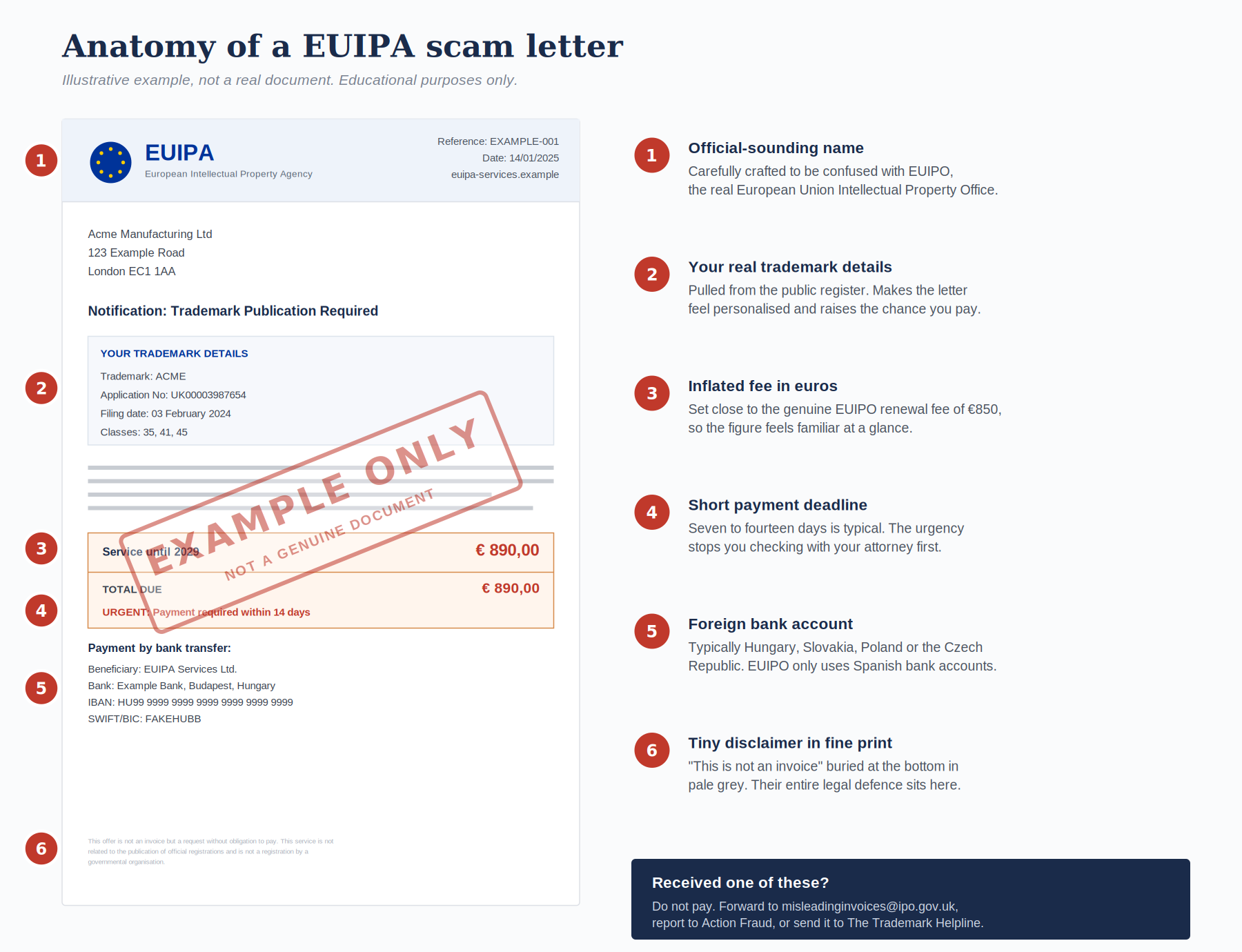
- The name “EUIPA” or “European Intellectual Property Agency” sits prominently at the top, often beside blue-and-yellow colours and star motifs designed to feel European and official.
- Your real trademark details are quoted accurately – name, application number, classes, filing date, and sometimes even a small reproduction of your logo.
- An amount in euros is requested, typically between €700 and €1,500. A favourite figure is around €890, suspiciously close to the actual EUIPO renewal fee of €850 for one class.
- A short payment deadline (often 7 or 14 days) creates pressure to act quickly.
- The bank account is in a country you might not associate with EU IP – frequently Poland, Slovakia, Hungary, or the Czech Republic.
- Somewhere in tiny print, often at the foot of the page and in pale grey, is a sentence saying that this is a private commercial offer with no connection to any government body.
That last sentence is the entire legal defence these operators rely on. They argue, when challenged, that they technically told you. The Advertising Standards Authority and the courts have repeatedly disagreed, but the disagreement tends to arrive long after the bank transfer has cleared.
Spotting the Scam
A few quick tells:
- The real EUIPO never sends invoices by post or email demanding payment for renewal or registration. All EUIPO fees are paid through their official user area.
- A genuine EU trademark renewal costs €850 for one class online. These scam letters land near that figure on purpose, so that at a glance it feels right.
- EUIPO uses two Spanish bank accounts only. Any invoice naming a Polish, Slovakian, Hungarian, or Czech bank is fake, full stop.
- No legitimate EU body demands payment within seven or fourteen days for something where nothing material happens if you don’t pay.
- If you have a trademark attorney handling your EU registration, all genuine correspondence goes through them, never directly to you. If something has bypassed your representative, treat it as suspicious by default.
What to Do If You’ve Received an EUIPA Letter or Email
- Don’t pay. Recovery is extremely difficult once the money has crossed a border, and these operations are designed to move money fast.
- Forward it to the UK IPO at misleadinginvoices@ipo.gov.uk. They want to see these.
- Report it to the EUIPO directly at information@euipo.europa.eu so it goes into their public database of misleading invoices.
- Report it to Action Fraud, the police-run fraud reporting service.
- Tell your local trading standards office.
- Send it to us. Either email enquiries@thetrademarkhelpline.com or book a free 15-minute call. We’ll tell you within minutes whether it’s genuine. No charge, no obligation.
What to Do If You’ve Already Paid
First, and most importantly, please don’t beat yourself up. Then:
- Contact your bank immediately and explain that the payment was made to a misleading invoice. Depending on how recently you paid and how, a recall or chargeback may be possible.
- Report it to Action Fraud.
- Forward the invoice to both the UK IPO and the EUIPO so they can update their records and warn others.
- Get in touch with us. We’ll walk you through whether your trademark is still properly protected, what (if anything) the scammers actually did or didn’t do, and what the practical next steps are.
The money may be gone. Your trademark, in almost every case, is still entirely yours.
One Last Thing
If you’ve landed here because an EUIPA letter just turned up in front of you, well done for checking first. That’s almost the single best thing you can do. The next best is to forward it to us, so we can give you peace of mind in minutes.
And the best thing you can do is share this article with your network. Every founder, every brand owner, every business that registered an EU trademark this year is a potential target. Most of them haven’t heard of EUIPA yet.
The biggest weapon against these scams isn’t enforcement. It’s awareness.
And if, having read this, you feel like you may benefit from affordable professional help with a UK trademark, book a free initial consultation or email us to see if we can be of service.
You can subscribe to our newsletter to keep updated on all things trademark-related, free business advice, and be the first to hear about trademark scams so you can stay extra vigilant.
Questions about this
Is the European Intellectual Property Agency the same as the EUIPO?
No. The official body is the EUIPO, the European Union Intellectual Property Office, based in Alicante. EUIPA, which stands for European Intellectual Property Agency, is a different name that differs by one letter. EUIPA is named on the UK Intellectual Property Office’s official list of misleading invoice senders and appears in the EUIPO’s own database of misleading invoices. A letter from EUIPA is not an official EU trademark fee.
 Answered by Jonathan Paton, Founder & CEO
How can I tell if an EU trademark invoice is genuine?
The EUIPO does not send invoices by post or email demanding payment for renewal or registration, as its fees are paid through its official user area. It uses two Spanish bank accounts only. Warning signs include a short payment deadline of 7 or 14 days, a bank account in another country, and small print saying the letter is a private commercial offer. If you have a representative, genuine correspondence goes through them, so anything sent directly to you is worth checking.
Answered by Jonathan Paton, Founder & CEOCan I get my money back after paying a misleading trademark invoice?
It depends how you paid. Credit card payments are usually the most straightforward to recover. Debit card refunds are notoriously difficult to obtain. Bank transfers are practically impossible to reverse, and the only recourse is a complaint to your bank, which is hard to win if the bank warned you about the payment. Recovery is especially difficult once money has crossed a border, so the safest step is not to pay and to check any unexpected invoice first.
Answered by Jonathan Paton, Founder & CEO