
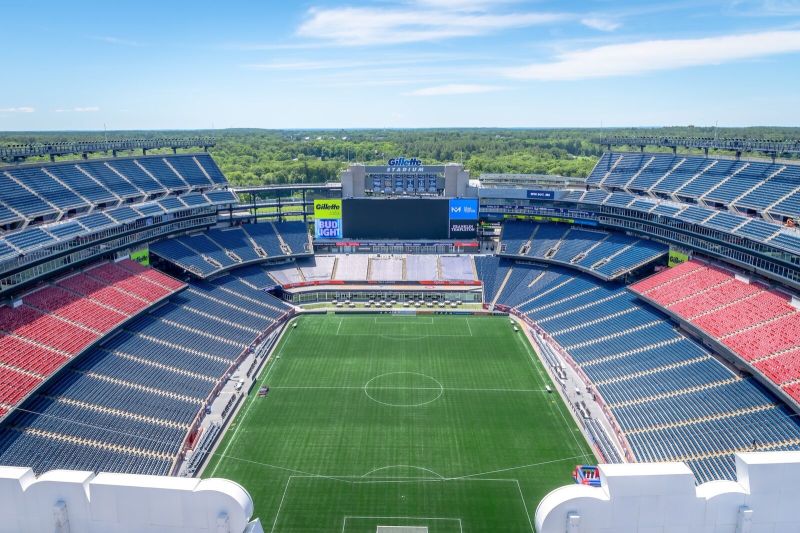
“Right, just cover the branding on every seat.” All 65,878 of them. That, more or less, is what has been happening at Gillette Stadium in Foxborough, which will spend the 2026 FIFA World Cup answering to a completely different name. For the duration of the tournament, the home of the New England Patriots is not Gillette Stadium at all. It is “Boston Stadium”, and the reason behind that quiet rebrand is one of the clearest lessons in brand value you will see all summer.
What FIFA’s ‘clean venue’ policy actually means
FIFA operates what is known as a clean venue, or clean stadium, policy. In plain terms, it means that any branding inside a World Cup venue that does not belong to an official FIFA partner has to be removed, covered or renamed for the tournament. That covers stadium names, logos, signage, scoreboards and, yes, the branding printed on individual seats. The goal is to hand FIFA’s official sponsors clean, exclusive visibility in front of a global television audience, with no rival names sneaking into shot.
Gillette is a Procter & Gamble razor brand, and it is not one of FIFA’s official partners, so for a few weeks its name simply cannot appear. The result is that a stadium which has carried the Gillette name since 2002 has to look as little like Gillette Stadium as possible, right down to someone painstakingly covering the logo on every seat in the bowl.
Why a razor brand had to disappear
It sounds almost absurd when you say it out loud, but it is a serious commercial exercise. FIFA expects to generate somewhere in the region of 1.8 billion US dollars from the sale of marketing rights around the 2026 tournament, and almost all of that money is tied to the men’s World Cup. When a sponsor pays that kind of figure for exclusivity, FIFA has to be able to deliver it, and that means no free advertising for any brand that has not paid to be there. A name on a stadium seat might look tiny and harmless, but when millions of people are watching from every corner of the planet, every visible logo carries value, and every unpaid one is a problem.
It is not only Gillette
This is not a one off either. Over on the west coast, Levi’s Stadium in Santa Clara, home of the San Francisco 49ers, is being temporarily renamed the “San Francisco Bay Area Stadium” for exactly the same reason. Levi’s, like Gillette, has paid handsomely over the years for the right to put its name on a stadium, and yet for this tournament that name has to step aside. When two household names are willing to vanish from their own buildings for a few weeks, you start to appreciate just how fiercely the value of a brand is guarded at the very top of the game.
The lesson for businesses of every size
It would be easy to file all of this under ‘big sport behaving strangely’ and move on, but I think there is a genuinely useful point in here for ordinary business owners. Major organisations go to these extraordinary lengths because they understand, better than anyone, that a brand is a real and protectable asset. The name, the logo and the look of a business are worth defending, and they are worth controlling.
The difference is that FIFA and its sponsors have the registrations, the contracts and the legal muscle to enforce all of this. Most smaller businesses do not, which is exactly why it pays to get the basics right early. If your name, logo or branding has value, and almost every business’s does, it needs protecting before somebody else causes you a problem. A registered UK trademark is the foundation that gives you the same kind of control over your brand, on a scale that actually fits your business. You will probably never need to cover 65,000 seats in blue tape, but the principle that sits behind it applies to you just as much as it applies to FIFA.